Web Analytics

Saturday, August 18, 2012

Nature has its own crayons


This morning I was checking my blog to find out as to how my previous post is faring in terms of “comments” received. There were no new additions to make me feel happy about. However, an uncharitable invite was peeping out to join the bandwagon of competitors for  Capture the color contest. Though it was not something unfathomable to identify photographs with the 5 colours but it was the thought of roping in 5 more gullible bloggers that was agonising. I also strongly feel the way Nisha has indicated while writing on the subject.
Its has now become incumbent on my part to make a quick search and produce whatever I have. I shall, however, desist from explaining the attributes, significance or otherwise of the various colors as they have been dealt with at length by many of my fellow bloggers so far.

THE RED:


Recently when I was on a visit to a wholesale fruit market in Chennai, I came across some red fruits looking like plums. On my enquiry, the vendor told me something in the vernacular which could not be registered in my brain.

GREEN:


On the 3rd of this month I received a telephone call from Coimbatore asking me to come out of my apartment at Chennai and to look at the sky to witness a beautiful view of the Sun having a disk around it. I went up and looked at the sky from the terrace of the building. It was all black clouds preventing the Sun to show off. This phenomenon was reported by our friend R. Ramakrishnan the same day in his post titled Disc around the Sun. While still on the terrace I looked around and noticed the Neem trees below full of fresh foliage.

WHITE:


White too has many shades. While at a garden in Srinagar, this flower known as Magnolia Grandiflora with its thick petals seemed something exotic.

BLUE:


Blue skies and blue waters have always been soothing to ones eyes. The Ekambareswara Temple tower (Gopuram) at Kancheepuram has a beautiful sky as its backdrop. I am yet to write about the splendid architecture of this temple complex.

YELLOW:


The Papaya fruits on sale at Chennai fruit market. They have great medicinal properties apart from being tasty. “Pepsin” is derived from raw Papayas used in many stomach ailments.

Now the most undesirable and uncharitable part of this post is to rope in 5 more blogger friends to carry the contest forward. With due apologies I list them hereunder:

Friday, August 10, 2012

Moving to Pahalgam – Sayonara Srinagar


10th June 2012:

It was an unique experience to be able to meet the family of our Shikara operator at their residence and be able to have a glimpse of the traditional houses in the secluded quarters. We were bidding good bye to  Srinagar and were proceeding to Pahalgam where we intend to stay for two days. Our vehicles were being loaded with our luggage. Looking back, we had regrets for not having been able to visit many other places of interest and importance in or around Srinagar. The Shankaracharya Temple (Takht-e-Sulaiman), Tulip Gardens, Shalimar Gardens (Our group is to be blamed), Pari Mahal, A boat cruise in Jhelum cutting through Srinagar, The fort on the top of Hari Parbat and shrines of Sharika Bhagawathi, Hamza Makhdoom and the Gurudwara (Chatti Padshahi) are some of them. They called for a further stay of 2/3 days to explore.

Front View
Backside View
Very old picture
Pahalgam is also a much sought after tourist destinations in Kashmir which is 94 kilometres South East from Srinagar. While making a move, we requested our driver to make a brief halt  in front of the arched gate at the foot of Hari Parbat. The locality is known as Rainwari and the massive gate itself is called  Kathi Darwaza. The vehicle stopped as requested and without wasting time I jumped out and went inside to have an appreciation of the inhabited area there. Once the Moghul emperor Akbar wanted to etablish a township in the fort precincts to be known as Nagar Nagor and a wall running round the hill was constructed.  I was looking for some kind of centuries old ghettoes but the houses/buildings seemed to be of recent origin. The present settlement inside is supposed to be unauthorised but then they are not devoid of civic facilities.

I had to remain contended with whatever I could see, although there was a road which probably leads to the top of the hill fort.  Getting inside would have entailed delays because of other inviting monuments in its precincts. After traversing through the narrow lanes we entered the highway within the city. There were many shops displaying colourful bowls and household utilities made of a kind of local reed. Farther ahead  were shops selling carved stoneware. Shortly we were out of the city limits and were proceeding to our destination at optimum speed. We had also requested for a stopover at Avantipur, 30 kilometres ahead. I was on the look out and while passing through a small town, a ruined structure to our left made its appearance and immediately I asked for the vehicle to stop. The vehicle was already slowed down and the driver responded that he remembered it. Yes this was the Avantipur I had in mind. The ruins still majestic in appearance stood there. It was a temple dedicated to Lord Vishnu built by a king known as Avantivarman during the 9th century CE which was destroyed by the non-believers as a part of their crusades in the 14th century CE. This deserves a separate post.

Avantipur Ruins
En route we came across several traditional houses in a state of disrepair and looked as if they have been abandoned. Some one amongst us also screamed “look at those houses, there is no life”. As a matter of fact I was so much engrossed looking at the beauty all around, I did not pay much attention. I remained oblivious of the fact that these were the houses of the original inhabitants of Kashmir, known as Kashmiri Pandits. Infiltrations and militancy in the valley made them to move out en-mass in 1990 leaving behind all their possessions. For a moment I was sad but then thought of diverting my attention. I requested the driver if he could take us through the country side so that we can have a feel of the rural life. Soon we came at a point where there was a diversion towards the right with a small hoarding which read “Apple Valley”. The driver was kind enough to heed to our request and leaving the highway drove through the narrow road. We came across a shepherds driving their flock of sheep for grazing. Our driver clarified that the name Pahalgam has been derived from these shepherds. Pahalgam means a Valley of Shepherds.


There were plantations of Walnut trees followed by Apple and Cherries. The fruits were either not visible or were too tender and small. Cultivation of Apples for which Kashmir was famous is now dwindling. The farmers have switched over to Cherries and Kiwis (native fruit of New Zeraland). The later largely gets exported to various countries. Then there were paddy fields as far as we could see. Women folk was engaged in transplanting operations in the water filled slushy fields. This sight was similar to what we could see elsewhere in India except that women here were well clad. There was a small village in between where they had good houses and some remnants of the past also existed. They were the wooden two storied houses since abandoned. There were similar structures where the lower portion had the shop and the upper portion was used as a dwelling. It seemed that the rural population is also fairly affluent. There were no traces of any poverty as could be encountered elsewhere in India.


After passing through few more villages, we were once again on the highway leading to Pahalgam. The Liddar river (originally Lambodari) on the way mesmerized us and we stopped on its banks to have a photo session with the beautiful views behind. This river is full of rapids and had we stayed there for some more time we could have had a rafting experience.


Finally we arrived at the main bazaar area of Pahalgam and had a late lunch at the Nathu’s Rasoi, one of the best in the town. 


Thereafter walked through the streets window shopping. We were booked at Hotel Baisaran but due to some communication gap, we could not be accommodated there. After several telephonic calls to the Hotel Centre Point at Srinagar (they were the people who arranged the package) we were led to a nondescript (but good) hotel some where up in the hill. Probably the village was Ladipura. However the surroundings were scenic. We checked in for a night there, only to move out next day early in the morning to a central location.

Father and Son


Wednesday, August 1, 2012

Gulmarg (Kashmir)


Literally the term Gulmarg refers to a place with abundance of flowers. Situated at a distance of 56 kilometres South West of Srinagar, Gulmarg attracts the largest number of tourists among all hill resorts in Kashmir. It has one of the longest and highest (12000 feet) ski slopes in Asia. This apart, the World’s highest (8700 feet) Golf Course is also located here.  Many of the foreigners who come here are  skiing enthusiasts, though there were very few of them when we visited. We were told that they arrive in large numbers during winter when the competitions are organized. Gulmarg was known as Gourimarg centuries back but in the 16th century Sultan Yusuf Chak excitedly called it as Gulmarg and the name lives on. This place was a favourite with the Emperor Jehangir of the Mughal Dynasty. He used to come here frequently and seems to have attempted to make out an inventory of various species of flowers growing here.

We were camping at Srinagar. By the time we were ready to proceed to Gulmarg it was nearly 10.00 AM. The hangover of our visit to Sonmarg a day earlier made us to sleep a little longer. The extra sleep energised us and we were geared to enjoy Gulmarg to the fullest extent.  We commenced our journey without wasting further time. Our driver had foretold the desirability of reaching Gulmarg as early as possible.  He was also in touch with the Guide who was waiting for our arrival. The road was quite wide and straight except a diversion. Soon we were at a township known as Tangmarg and it took only 40 minutes to cover the distance of 40 kilometres. From here we had to climb a mountain on a narrow winding road. But before that we were required to equip ourselves with heavy winter clothing,  e.g. gum boots, hand gloves, fur caps etc. We also procured long rain coats as well, keeping in mind the previous day’s experience at Sonmarg. All these gears were available on hire at that point. As said earlier, the road up the hill was narrow. We were told that during winter tourists can come up to this point only and thereafter they need to board special vehicles which are equipped with chains on their wheels. This facilitates navigation through the snow covered path.


We continued our journey on the mountain road with Pine trees all around. This stretch needs about 30 minutes drive to cover around 15/16 kilometres. Finally we arrive at a point with a gate to the left and disembark from our vehicles as tourist vehicles are not allowed to enter. Nevertheless  there was a road leading inside with meadows to the right as far as the eyes could see. To reach the snow covered mountain ranges, we had three options. We could go on horse back up to the foot of the snow clad mountains or reach the base station for the Gondola (Ropeway) service.  Horses/Ponies were available to our right but we decided to walk the distance and followed many others who were on their foot. Although we could have covered some 2 kilometres, it was a pleasant walk passing through the beautiful tourist villas/cottages to our left. Very soon we were at the Gondola Station which had a very long queue in front of the ticket counter. Fortunately our Guide was with us who volunteered to fetch our tickets for the Gondola ride. We escaped from locating the tail end of the queue and standing there for our turn. Perhaps the guide had only such jobs to perform and was fully experienced. Incidentally Kashmir is also plagued  with corruption at every level.


The cost of the ticket was Rs.300.00 per person including children above 3 years and that too up to the 1st stage at Khilanmarg (Kungdoori). On getting the tickets we proceeded to board the Gondolas. After a little wait we moved in. The Gondola has a seating capacity for 6 and is fully covered. One can, however, get the beautiful views through the transparent panels (wind screen). Use of cameras got restricted as the wind screen was not clear enough to obtain sharper images. During our upward journey we came across small huts with flat roofs beneath. Some kind of vegetation was visible over the roof tops, a rustic kind of roof garden for growing seasonal vegetables. It did not take much time to reach the first stop at Khilanmarg where we were required to get down. Once again we needed to buy tickets for our onward journey to the 2nd and final  stage at Apharwat costing Rs.500.00 per head. Now we were very close to the snow covered hill slopes of another mountain. The ticket counter here was also over crowded but we were not much concerned as we had with us an experienced guide!.


We observed that the the issuance of tickets was being interrupted followed by announcements about the bad weather conditions uphill. It was resumed within 20 minutes or so and then again a similar announcement followed. We, leaving our guide back, engaged ourselves in exploring the area. We learnt that another rope way from here, a Chair Lift,  which was not operational at that time, goes up to the snow covered mountain slopes ahead where skiing competitions are held during winter. Snow Rugby matches are also organised occasionally. The skiing slopes known as Marry Shoulder is supposed to be one of the best in the world. They charge Rs.200.00 per head but children below the age of 10 are not permitted to board the Chair Lifts which have a capacity for four. 


After about an hour and half, we had our tickets and could board another Gondola to take us to Apharwat. The onward journey commenced. After some time we found ourselves amidst clouds and it started raining. The gondola stopped in the mid air and after remaining suspended for some time we were on the go. Finally we entered the Gondola station where we readied ourselves to get down but the doors refused to open. Lo! we were returning. We could perceive that the weather conditions were not conducive thereat. Finally, after being airborne for over 40 minutes, we were back at Khilanmarg. Another ride on the Gondola brought us to the base from where we walked back to the main road. We reached our vehicles and headed to Srinagar.


Though we regretted for not having been able to disembark at the top of the mountain, at least I was a bit relaxed for I could have had problems in breathing at that height of over 13500 feet. Nevertheless all of us were happy for at least having had an opportunity of riding the most elevated ropeway in the world. Gulmarg is an all-weather resort with refreshing summer meadows and pastoral scenes. Its legendary beauty, adventure opportunities, prime location and proximity to Srinagar naturally makes it one of the premier hill resorts in the country. The beauty all around is heavenly.

Note: Online booking facility (E-Tickets) for Gondola tickets for both the stages is available at:

Monday, July 23, 2012

Sonmarg (Kashmir)


Memories of Sonmarg bring shivers into my spines. I am just recapitulating the enthusiasm we had while proceeding to this place which withered away eventually. That could have been one of the most enjoyable trips but we underwent extreme suffering due to our own faults and lack of proper guidance. Sonmarg which means 'Meadow of Gold' lies some 87 kilometres North East of Srinagar on the highway leading to Leh in Laddakh (topmost area of India). If one continues the journey on that highway for another  9 kilometres, one would reach Joji La (Pass) which is a vital link between Srinagar and Leh. Since we were not heading towards Leh, we stopped at Sonmarg. An important glacier known as Machoi is approachable from here at a distance of 8 kilometres towards the right. The melting ice of the glacier forms a river known as Sindhu which flows for 108 kilometres and becomes a tributary of the river Jhelam. On the way to Sonmarg this river flows parallel to the highway (NH 1D) most of the time and affords a beautiful view against the backdrop of the mountain ranges. The flowing waters, greenery created by the Pine trees and other vegetation makes the drive enjoyable. We were happy for we thought we were seeing the famous river Indus (called Sindhu in India) but we were mistaken. The river Indus has its origin in Tibet and passing through Laddakh it flows through Pakistan.


On 8th June 2012 we had our breakfast in the morning at Srinagar and could reach Sonmarg by Noon. There were several temporary shops on the left providing overcoats, hand gloves, woollen caps, gum boots etc. on a rental basis. The ground in front had wet mud all around and was slushy, a place for all the ponies waiting for customers. The shops there arrange for everything you need, including ponies.  The economic principle of demand and supply becomes operational when it comes to determination of  per head charges. It is obvious that it varies from time to time.


It was drizzling when we reached there but soon the sky was clear and the weather looked inviting. We geared ourselves putting on the overcoats and other things and finally were on the horse back for the 8 kilometre ride. The caravan proceeded towards the glacier scaling the steep ups. While we were mid way, it started raining. We were wearing woollen overcoats which got soaked in rain water and created discomfort. By the time we were at the foot of the glacier, we were completely drenched and shivering because of extreme cold. All of us were riding a horse/pony for the first time in life. Fortunately at the point we got down, there were numerous temporary sheds where hot tea was available. There was a fire place where we could get some warmth. But that was  of no avail because the moment we got out it was a back to square one situation.


The glacier stood before us and some how we prepared ourselves for the climb. You are pulled up on a sledge which is a wooden plank by the people rendering this service. Their charges are also negotiable. There are some imaginary points across the glacier viz, 6, 12, 24 and so on. One could choose any one of them and the farther you wish to be carried, you need to pay more. We settled for a point described as 24. The journey upwards over the sledge was cumbersome as you need to balance yourself. I fell down twice. We were still shivering and the height at 13500 feet had a telling effect. Abruptly, even before we could reach the so called point 6, the man pulling the sledge asked us to get down and cover the steep stretch by foot. We did the short trek but then got exhausted. We were unable to breathe properly. There was no strength left to go any further. We settled ourselves on the snow unable to make any movements. There were cries in the air. A child aged 9 or 10 was weeping profusely. We then decided to return back. Even on our way back we got thrown out of the sledge because of the steep slide.


Ready to go back
We came back to have another round of hot tea and getting some warmth at the fireplace of the tea shops. Looking back at the glacier we realized the beauty of the place but failed to appreciate it to the extent it deserved because of fatigue, physical as also mental. Now we were looking for our horses/ponies and they got located soon. While returning from the glacier, over the horse back, we were going down and at many places it was very steep. It seemed to be a very tiring exercise to remain at 90 degrees and balancing ourselves while the horse was  manoeuvring  through very narrow passages circumventing large boulders, stones and cavities. Finally we reached the place where our vehicles were parked.

Our driver immediately came to our rescue. He pulled out our gum boots and socks and to our horror we found ice pieces coming out along with water. Thereafter we removed the drenched overcoat and other things which were sent back to the shop owner. We also removed our shirts and pants and  got seated inside our vehicles. The heater was turned on and we were feeling better after 10/15 minutes.

We had observed that there was a good road going to the glacier from Sonmarg but only the local vehicles (other than taxies) were permitted. Probably this practice is in vogue so as to enable the local horse/pony keepers to make a living.

The greatest blunder we committed was by not insisting for rain coats. The weather conditions in high altitudes are not predictable. But then we were provided with woollens only which got drenched and created all the problems.


While returning to Srinagar, we stopped at a wayside restaurant and had our late but hot lunch. The Alu Parathas (bread with potatoes) was heavenly.
Nevertheless it was an experience more akin to an adventure.


Thursday, July 12, 2012

Jamia Masjid (Mosque) - Srinagar


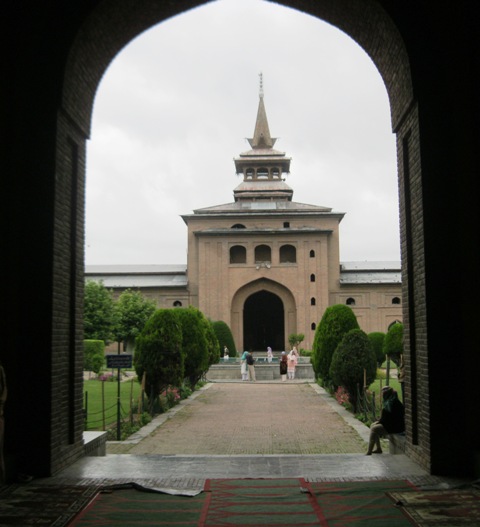
After having visited Hazratbal, we thought of going to the Jamia Masjid (Mosque) at Srinagar. However, our driver had some reservations. He informed that the Mosque is at the centre of the old part of the city and is a disturbed area. Cannot be considered to be very safe. Then he remembered that it was a Thursday and not a Friday. Fridays are special  when the area is fully crowded for the prayers at the Mosque. (Before I could make out a post, there was a news that a 300 year old “Dastagir Sahib”a holy shrine of the Sufi order, went into flames under mysterious circumstances. To contain the violence that followed, curfew has been clamped through out Kashmir. Even people have been restrained from offering their Friday prayers at Jamia Mosque on the 29th June) Therefore the driver obliged us and took us through the streets of the old city. From an otherwise thinly populated areas we were proceeding  towards high density area. 


The houses and buildings on our way  had a an old world charm and we could not resist clicking our cameras. Soon we noticed a tall tower at a distance resembling that of a church but then our driver corrected us saying that it is the Jamia Masjid.


We were now crossing a main road to go down. The mosque was at a lower elevation and now it was in full view. The main entrance is from the Southern side. The mosque seems to have had entrances from North and East as well. There is a broad lane surrounding the mosque with show rooms and shops on one side stocking items ranging from cloth, utensils, handicrafts and other domestic needs. It is said that the market here is cheaper as they primarily cater to the needs of the local population.


The arched doorway is huge but then the pagoda type superstructure  resembles that of a Buddhist shrine. There are no domes and minarets which we generally find associated with mosques. Practically all mosques in Kashmir are devoid of domes. The mosque is supposed to be a unique representation of the Indo-Saracenic architecture.


On entering through the main doorway, we find a magnificent square courtyard with well maintained lawns and ornamental trees. Towards the West is the main prayer hall wherefrom the Imam (Head Priest) directs the congregation. Just in front of the main prayer area there is a large square pool with flowing water used for ritual washing of hands before entering the hall for praying. There is a LED display board inside which shows the exact timings for the 5 times a day  prayers. This main complex is surrounded by a very broad corridor on the other three sides with fully carpeted flooring.


The Jamia Masjid is located in the Nowhata area of Srinagar. This was got constructed by the local ruler Sultan Sikandar in the year 1400. Later extensions were carried out by his son Jain-ul-Abidin. As said earlier the architecture is of Indo-Saracenic type. As a matter of fact it is an amalgam of Gothic, Mughal and Indian styles. Here they have used fully baked bricks for the whole construction. It has a wooden ceiling over which corrugated tin sheets have been placed angularly to facilitate easy clearance of snow during winters. the ceiling is supported by 370 very tall pillars made of pine timber. The mosque has a capacity to accommodate a congregation of 33333 people under its roof. Unfortunately this mosque too had to suffer great amount of loss due to fire which broke out at least thrice so far. The last renovation after a major fire was carried out by a Hindu ruler Maharaja Pratap Singh during the later part of 16th century.

Amongst all the mosques we have seen in India, this one is unique and justly called the pride of Srinagar.

Hazratbal (Srinagar)


Very close to the Nishat Baug at Srinagar there is a very famous place known as Hazratbal. Once it was a village which now is a suburban locality of Srinagar. “Bal” literally means  a place and it is some times misconstrued as “Baal” meaning “hair”. Hazratbal if literally translated could mean a holy place. Interestingly it does have an association with the  “hair” of the Prophet Mohammed, the precursor of Islam. It is believed by the muslim community of Kashmir that a strand of hair from Prophets beard is preserved at a shrine thereat which is also referred to as Hazratbal. A gang of terrorists even occupied the shrine with an intent to take away the holy relic and in the shoot out that followed, the security forces succeeded in eliminating them. Even thereafter there had been few skirmishes. Now it seems that peace has finally dawned. There are hundreds of pigeons here and people say that the white ones, representing peace, are on an increase. Because the entire area is sensitive, security forces have been posted at the shrine.

The structure as it appeared in 1920
The holy relic gets exposed to public view five times a day for the whole week during during Eid-e-milad and Meraj-un-nabi celebrations. Thousands throng to this shrine during those occasions just to have a glimpse of the relic. It is said that during the beginning of the 17th century a high official of Shahjahan’s court got constructed a beautiful building (Isshrat Mahal) with gardens spread out. In those days the surrounding area was known as Sadiqabad. When Shahjahan visited the place in 1634 he ordered the building to be used as a prayer hall. Historians are of the view that the relic was brought to India from Medina by one Syed Abdulla a descendant of the Prophet, who settled down at Bijapur in Karnataka. After his death the relic came into the possession of his son Syed Hamid. But then the area came under the attack of Mughals who annexed it. During the turmoil, Syed Hamid lost all his properties and was not able to take care of the family relic. He, therefore, sold it to a rich Kashmiri merchant named Khwaja Nur-ud-din Eshai. When Aurangazeb (Mughal emperor) came to know about this, he got the holy relic confiscated and sent it to the shrine of Khwaja Moinuddin Chishti at Ajmer. Nur-ud-din Eshai was arrested for possessing the relic and jailed at Lahore (now in Pakistan). It seems that after some time Aurangazeb’s conscience deplored his own actions and then he decided to return the relic to it’s owner Nur-ud-din and set him free. However by that time Nur-ud-din, while in jail,  had already departed to his heavenly abode.

It was in 1699 that the remains of Nur-ud-din Eshai’s body as also the holy relic were brought to Kashmir. Inayat Begam, daughter of Nur-ud-din got the remains of her father’s body cremated and a shrine erected at Hazratbal. She also took the holy relic under her protection. The present structure made of marble was constructed by the Muslim Aukaf Trust administered by Sheikh Abdulla (a renowned politician of yester years). The construction started in 1968 and got completed in 1979. The shrine, apart from religious activities, was also a nerve centre of all political activities at Srinagar. Sheikh Abdulla used to address the public from this venue and became very popular. After his death, his son Dr. Farooq Abdulla desired to have  control over the affairs of the shrine but terrorists had a upper hand from 1990 onwards. The shrine proved to be a safe heaven for them.


We roamed about the residential areas adjoining the Shrine and then proceeded towards the left. The road was going down, not steep though. To our right there was one opening leading towards the left side of the Holy Shrine. Amidst a well laid our lawn, there were some ornamental trees.  The main dome of the shrine had scaffoldings and it appeared that some restoration/repairs were being undertaken. There was a group of Kashmiri women at the extreme end of the lawn singing and rejoicing. We asked a gentleman there, probably belonging to that group, about the happenings. We were told that a family from a nearby village had no issues and they had prayed at the Shrine earlier. As a result a baby was born and that the family has brought the child here and were expressing their gratitude. We sought their permission to take few photographs and they gladly agreed. After enjoying their traditional group song with the accompaniments, we proceeded towards the shrine. There were not many tourists. Most of the people there were local women who were entering a side hall to offer their prayers. We had a peep through a window. When we were proceeding towards the front side, we encountered few security personnel. We once again enquired if it would be proper for us to take photographs. We were advised not to do so inside the hall leading to the main Shrine (tomb). There was a covered porch outside through which we could enter the main hall, The hall was fully decorated and carpeted and looked like the hall of a church without the seating arrangement (benches). Thereafter we came out and we were on the main street after passing through an arched gate.


The visitors from different parts of country generally  pay a visit to the shrine. In the past, even the political delegations, including from the BJP, also made it a point in the past to pay obeisance at the shrine. Former prime ministers Indira Gandhi and Atal Behari Vajpayee, and Presidents Neelam Sanjiva Reddy and APJ Kalam had also visited the shrine. But now a days It seems that tourists are not very comfortable coming here as it is perceived that any thing could happen anytime.


Here is a small video: