Web Analytics
Showing posts with label Architecture. Show all posts

Monday, October 8, 2012

Avantipur (Kashmir)


We were actually heading to Pahalgam but as we had instructed, our driver stopped the vehicle in front of the Avantipur temple ruins which were on the way. In one of my earlier posts, I had mentioned about a visit to this place which is around 30 kilometres South East of Srinagar and the attraction being the ruins of a 9th century temple. My friends were intrigued for they had known about one Avanti in central India, sometimes misunderstood as being the ancient name of Ujjain. On the lines of the Greek city states, India during its classical age had 16 republics known as Mahajanapadas known to us through ancient literature and religious texts. Avanti or Avantika was one such region. One of its capitals was Ujjain or Ujjaini.  Avantipur on the other hand was once a capital of Kashmir.


The imposing ruined structure was before us. A watchman posted there advised to procure tickets from the counter at the left. We obeyed the instructions and found a Sardarji (Sikh gentleman) sitting there. There was a notice board which contained the entry fee payable. Additional levies were prescribed for  still cameras and video cameras. Before I could tender the cash, Sardarji enquired “yes sir, where are you from”. We told them that we are tourists and are interested in taking some photographs. His next anxiety was to learn about me as to my vocation and if I am employed. I said I am no more in service and casually (or may be to establish my credibility) told him that I am an amateur archaeologist. Perhaps my words were music to him as he instantly said Sir, you need not buy any tickets. For you it is free. I apprised him that we are in all 10 to which he countered, so what?. My next query was what about the cameras we are carrying. He said in a typical Punjabi tone “who prevents you”. Thereafter I called in all the people who were still tied to their seats in the vehicles.

During the 12th century there lived a highly learned sanskrit scholar and poet in Kashmir whose name was Kalhan. He was the author of a work known as Rajatarangini (a history of ruling dynasties). He states that Raja Avantivarman (855 – 883 AD) of the Utpala dynasty founded the city of Avantipura in an area known as Vishwaiksara  where Hindus performed religious rites for the salvation of their dead. The jhelam river (ancient name Vitasta)  was also nearby. Such a presence of a water body is not only ideal, is also necessary for the religious rites. We could infer that the place was considered to be a holy one much before the establishment of a City named Avantipura. Avantivarman, the King, was a follower of Vaishnava cult ( a Vaishnavite – worshippers of Lord Vishnu) and he continued to be so till his death. It was he who got a grand temple constructed for his Lord  during the 9th century. The central deity installed in the Sanctum Sanctorum was christened as Avantiswamin. The King had a minister named Sura who was very dear to him but Sura was a worshipper of Lord Shiva. Therefore Avantivarman got another equally grand temple constructed for Lord Shiva just a kilometre away. The temple is known as Avanteeswara which is also in ruins. Unfortunately we were not aware of its existence at such a short distance and we missed it.

Sultan Sikandar Butshikan, the 14th century ruler of Kashmir hailed from Afghanistan. To appease a spiritual leader Syed Ali Hamadani in that country, Sultan Sikandar engaged himself in a crusade and ended up in the massacre of Kashmiri people and destroying their holy places ruthlessly. All kinds of stage plays including music and folk songs, folk dances etc. were banned. Consumption of wine/liquor was made an offence. People were compelled to embrace Islam for fear of life. It is said that in the entire Kashmir only some 11 Hindu families escaped. We could perhaps draw a parallel with the Talibans of Afghanistan. Along with other temples, the Avantipur Vishnu temple was also not spared. However, it is said that the construction was so strong that it took over a year to have it demolished,  part of which still remains to tell us its past glory. Sultan Sikandar’s title “Butshikan” itself means a destroyer of Idols. Incidentally his second son Jain-ul-Abidin (1423 – 1474) was tolerant and considerate towards Hindus. He came to power after his brother proceeded to Mecca for a pilgrimage. However by the time Jain-ul-Abidin came to the scene, none of the Hindu temple structures had survived.


There was a well laid out pathway leading to the main entrance. The huge door,  made of lime stone blocks approachable through a flight of stairs stood majestically. The upper portions were in a broken condition together with the tall massive columns with ornamentation. The intricately carved main entrance would have been a sight to behold. Apart from the destruction it was subjected to, weathering has also played its due role. Many of the sculptures are now difficult to be recognised. The temple is rectangular with a huge courtyard measuring 170.6 x 147.6 feet. After entering through the main entrance we need to go down for being in the courtyard. There is yet another elevated structure at the middle with stairs leading to the sanctum sanctorum. There is an array of cells arranged around the periphery of the paved courtyard similar to Buddhist Viharas. We are not certain as to the purpose of those small rooms/cells. Could only presume that either they were used for meditation facing the central shrine or for placing large sculptures.There are remains of four smaller shrines at the four corners of the courtyard. 


During the  early part of twentieth century excavations were carried out by a team headed by D.R. Sahni resulting in the reclamation of the temple ruins up to the floor level. The excavation yielded a rich crop of antiquities including 121 coins issued by Toramana, Sultans of the Shah Miri dynasty, Durrani Afghan rulers etc. Sahni also excavated the quadrangle of the Avantisvara temple and brought to light a small earthen jar having 108 copper coins issued by various rulers, fragments of birch manuscripts containing accounts of articles of worship, inscribed earthen jar etc. The sculptures from this site are presently displayed at Srinagar Museum.

Temple architecture is supposed to have reached its zenith during that period with some sprinklings of Gandhara and Greek styles.

The Avanteeswara temple, a kilometre away and the Martand Sun Temple 8 kilometres away from Anantanag (Islamabad) built by Lalitaditya in the 8th century, though in ruins, are similar in style and construction. However, we were not fortunate enough to visit them.

Tuesday, May 15, 2012

Mahabalipuram - Shore Temple


We had a stop over at Chennai while returning from our Kerala trip. One day my younger brother wanted to visit Mahabalipuram and I was happy to join him for it was many years ago that I visited the place. Incidentally I ought to tell that Mahabalipuram is around 60 kilometres South of Chennai on the way to Pudussery (Pondicherry). It was a bright sunlit day and quite warm under the Sun. In less than 2 hours we could reach Mahabalipuram which was earlier known as Mamallapuram.


We headed straight to the famous Shore Temple, known so, for it faces the Bay of Bengal and is just on the Shore. It is supposed to be one of the oldest structural temples of South India. 

I believe  a little bit of history could be tolerated. There was a great dynasty known as Pallavas who were ruling that area with their Head Quarters at Kanchipuram between the 3rd and 9th centuries CE. They were sea farers and Mahabalipuram was their main sea port,  for access to South East Asia as also Sri Lanka as evidenced by various artefacts/coins found thereat. One of the dynasty’s illustrious ruler Rajasimha Atyantakama (he had several titles) was reigning during the 7th century.Needless to say that he was a great conqueror and would have carried out several missions to expand his empire.   During that period Pallavas were   the strongest military power in the Sub Continent. Without going into controversies, we may conclude that the artisans would have been brought in from central/western parts of India where rock cut temple construction was in vogue. They were put to work at Mahabalipuram (we shall be speaking about the marvellous rock cut creations thereat in a separate post).


When we look at the Shore Temple from a distance they look like two pagodas but when we are in, we find three temples in a row. We were talking about the artisans/masons (not to be misconstrued for the free masons of the Masonic lodge!). To begin with they were instructed to carve out a Vishnu (reclining) shrine out of a monolith on the shore. They did their job well and their skills having been tested, were then assigned many other structures to be carved out at some distance.


The reclining Vishnu appears to have been the earliest creation as per a label inscription found on the lintel of this temple, calling it “Narapatisimha Pallava Vishnu Griham”. Narapatisimha is a title of Rajasimha. Then followed the construction of other two temples, but not immediately. It has probably been done after about 50 years  to appease the sentiments of a larger faction of Hindus who were staunch believers of Lord Shiva. Thus this is seen as a balancing act on the part of the royalty.   In the process Lord Vishnu got sandwiched between two shrines dedicated to Lord Shiva.


As said earlier, after carving out a Vishnu's (Reclining form known as Anantashayana) out of a megalith, two more shrines for Lord Shiva got constructed with dressed up granite stones. The smaller one in the front and a larger one at the back and in between sleeps our Lord Vishnu. Some suggest that the smaller one facing west was originally the mandapa (porch)  for entry  to Vishnu's shrine but we could not find any opening as such. However, the wall adores a Somaskanda (Shiva). Supposedly there was a Shiv Linga (Phallus) which is now missing.


The larger temple at the back (facing East) was not open that day. There is said to be a large (broken at the top) Shiv Linga with sixteen faces made of polished granite and also a Somaskanda on the wall identical to what we have seen at the smaller temple facing West. There are many other sculptures in and around the temple which have eroded to such an extent that  it is becoming difficult to identify them. We therefore, instead of spending time on that, decided to  go round and circumambulate the shrines.  We could discover the following three inscriptions which holds clues with regard to this complex..

This was probably  in the smaller Shiva Shrine


While moving clockwise, we figured an oval tank in the centre of which there was neat hole of about 8 inches with a clean cut slot to serve as a lock.  This is generally done to hold things securely. Probably a Shiv Linga was located there. But then there is a beautiful pillar quite tall looking like a Capstan of a ship just in front. We could not figure out what it is and with what  purpose. Since there is an opening on one side, we assumed that it could have been a very small shrine. The same tank also accommodates a rock cut damaged boar, an incarnation of Lord Vishnu.


Within the tank like structure, we also came across two sculptures, one seems to be that of Shiva on the Bull and the other one remained elusive.


While moving southward, we encountered a large seated lion which in itself was a shrine for Goddess Durga with an opening in its chest with a seated Durga.


Some other photographs relating to the site:

Such structural pieces remains scattered all around
This Ganesa is difficult to locate
While concluding it would be pertinent to add here that the site is supposed to have had 7 pagodas as stated by Marco Polo. 5 of them are supposedly swallowed by the Sea leaving the two, we now see. However deep water explorations by the ASI (Archaeological Survey of India) only reveal the existence of a wall stretching into the sea and no more than that. Of course some of the fragments of the existing structures do surface when the sea recedes.

Now we are moving towards other part of Mahabalipuram where the rock cut temples etc. await us. 

Saturday, September 24, 2011

KANDY – CRADLE OF BUDDHISM


Kandy is the cultural capital and also the second largest city in Sri Lanka. It was the Kandyan Kings who nurtured and propagated Buddhism together with this town. According to a belief, Buddha’s tooth relic was smuggled from India  so as to protect it from the so called evil kings. They believe that the tooth relic brings in prosperity to the land where it is kept.

Tamil is the official language in addition to Sinhala and most of them converse easily in English or Tamil. We were advised in the beginning not to engage in conversation on controversial issues with the natives. There is some amount of mistrust between the Tamils and Sinhalese. At the same time we also found many of the temples being renovated even in lesser Tamil dominant towns.

Sri Lanka has a very good road network through out and reasonably good rail connectivity, of British Era, between major cities. We wanted to feel both the experiences and planned to take up the 3 hour bus journey from Colombo to Kandy, to begin with.

In about an hours time, the bus reached hilly terrain, leaving behind the hot and humid coastal planes. The bus was almost full. A Sri Lankan girl sitting behind me showed the point to get down to reach the elephant orphanage at Pinnawala. It was originally started as an orphanage for elephants and calves that are handicapped by landmine explosion. Now it is one of the biggest centres for Asian Elephants. She also showed us some other points of interest like the rail museum, and the botanical gardens while travelling in the bus. In between an elderly women kept her heavy baggage below the seat of our son, depriving him of the comfortable leg space. Our Son Achu wanted to convey his displeasure but I stared at him to keep quiet.

We had  booked a room in “Sevana Lodge” Kandy well in advance. It had basic facilities like airy rooms, good linen, neat toilets and  hot water shower. The owner with her family is living downstairs. She has converted the 1st 2nd and 3rd floors into a Guest house.

Auto Rickshaws (Tuk Tuks) are available through out though the cheapest and best mode for local travel is the town buses.

Kandiyan people are beautiful. They are not very fair but have good features possibly due to the traditional classical dance form they practice. We got a glimpse of one such dance in Kandy. It resembled a war dance and had combination of excellent reflexes, songs and rhythm of drums.

Kandy has a beautiful lake in the middle, beside the famous Tooth Relic Temple, (Dalada Maligawa), the most sacred of all the Buddhist centres in the world. The ticket costs SL Rs.1000/- for foreigners and SL Rs.500/- for SAARC country citizens. The Structure was partially damaged once by the LTTE bombers killing eight people.

Sri Lankans are big fans of elephants. Elephant tusks (ivory) are displayed in all Buddhist shrines. The annual festival of the tooth temple (resembling the Dussera of Mysore) and the procession involving elephants and Kandiyan Dancers is world famous.

Sri Lankans have better civic sense compared to Indians. The towns and cities are kept clean. Parts of Kandy town, its junctions, roads, old buildings and sub-ways resemble some unknown town in England or Europe. Yes, the influence of the Colonial past. Unpredictable rains added to the charm.

The second major attraction in Kandy, the Royal Botanical Gardens at Peradenia, five miles away from the town, is the home for the rarest species of plants in Sri Lanka. Said to have set up in the 13th century by the Kandiyan Kings, this 150 acres garden is a professionally managed centre displaying botanical wealth of Sri Lanka. The creative and scientific method of display of different species is praiseworthy. There are sections allotted for different species having different variants of same species found in the sub continent. One cannot finish the whole area in a day. We spent half a day in the garden. A must visit place in Kandy.

We also visited a hill town, Nuara Elia, located about 70 miles south of Kandy, famous for the tea plantations described as the Switzerland of Sri Lanka. Europeans preferred to stay here for the cool weather. It is also an escape for the Sri Lankans from the scorching heat of Colombo. Paucity of time and non availability of train ticket forced us to reduce the trip to a one day affair hiring a cab, which costed us SL Rs.4000/-. It was school holiday time in Sri Lanka.  The hill station has under it a vast area of tea gardens and associated processing centres. A very big lake and a beautiful garden are the major attractions.

We found here a temple dedicated to Goddess Sita (Sita Elia). According our Ramayana, this area should have been Ashok Van. The priest showed us the footprints of Hanuman who landed here in search of mother Sita sitting below a Ashok Tree.

It was great to witness the expertise and professionalism with which the PWD people work here. It took only an hour for them to clear the road block caused by a landside in the Nuwara Elia- Kandy Section. JCBs were being put to use to remove the earth and big cutting machines removing the fallen trees.

While returning from Kandy, we opted for Train Journey. Only 3rd class tickets were available, obviously the cheapest. Train journey offers most of the panoramic view of the hill country. Excellent Sri Lankan Tea and some snacks were provided to us in the train. Overall, the two and half hours train journey from Kandy to Colombo was the highlight of our trip.

Authored by: PN Sampath Kumar,
                  Cochin Shipyard, Kochi.
Second of the Series

Wednesday, September 14, 2011

Sigiriya (Sri Lanka), A Palace in the Sky

A Guest Post by:
P.N. Sampath Kumar,
                                  Cochin Shipyard, Kochi                                  


I heard of Sigiriya, the historical monument in Srilanka for the first time while surfing internet in 2004 when my colleague in the office entrusted me with the job of planning his vacation in Srilanka. Considering the risk of travelling too much deep into that country due to the turbulent political situation and also the difficulty in climbing the number of steps for his ailing wife prompted him to opt out that option. But those inputs initially saw the seeds of curiosity and longing to visit this place at an opportune time.

Magestic Sigiriya Rock
For SriLankans “Sigiriya” is more than what our Taj Mahal is for us. Derived from the root Sanskrit name Sinha Giri (meaning Lion Mountain) this city used to be the capital of the 5th century King “Kashyapa”(479 – 497 AD). The Story goes that King Kashyapa, the son of Dhatusena (King of Anuradhapura – 50 KM north of Sigiriya) and half brother of Prince Moggallana killed his father fearing that his half brother would be appointed as the next king. He shifted his capital from Anuradhapura to Sigiriya and created this beautiful city in a span of, they say, 7 years. Sigiriya provided an ideal place for a fortress as it was in a difficult-to-approach remote area. His half brother Dhatusena though fled to India fearing for his life, came back stronger after few years and defeated his brother Kashyapa in a war. It is said that Kashyapa committed suicide by cutting himself, not wishing to die at enemy’s hand. The site became a monastic refuge after his death. In the 16th and 17th centuries, it served as an outpost of the Kandyan kingdom but later went into ruin and was rediscovered by a British archaeologist Mr. H.C.P. Bell.
 
All these in the backdrop of my mind, we included this site in our itinerary during our vacation to Srilanka in mid April 2011. We were staying in Kandy, in central Srilanka. It was a Sunday morning, after breakfast (we came across a couple of south Indian restaurants run by Tamils in Kandy) we proceeded to Sigiriya by a hired cab on a one day trip. Our Driver ‘Tamura’ from ‘Kandy Cabs’ was a nice boy who understood little Tamil and English. As advised by Ms Shakuntala, the owner of the hotel where we stayed, we got sufficient sandwiches, flavoured milk packets and bottled water parcelled for the journey. Itinerary included visit to Dambulla cave temples also en-route.

Kandy has unpredictable weather. We feared rain en-route as it was playing hide and seek for the last two days in Kandy. After a few miles (it is all miles and yards in Srilanka) alongside the Mahaveli River, and later through the reserve forest, we reached Matale town. We took a break there to have a cup of Srilankan tea and later walk around the big goddess temple (Muthu Mari Amman) in the middle of the town. I was told that Mahatma Gandhi has once visited Matale in 1927 and laid foundation stone for one school here.
 
Mariamman Temple at Matale
We furthered our travel through paddy fields and coconut plantations. The journey through the unknown land was pleasant. Paddy fields are getting ready for sowing. Farmers ploughing the land with buffalows is a usual scene. Air smelled mud. Occasional scenes of houses resembled the Malabar Coast in India. The tiled houses there are the most suitable for the rainy whether. On both sides of the road, there were shops selling bananas, fruits and vegetables and tender coconuts. Tourism is becoming a serious business. It was nice to see big Banyan trees on both sides of the road. Thanks to the conscious effort on the part of the government. Banyan trees are great source of Oxygen and even prevent depletion of ozone layer, they say.

Huge Buddha at Dambulla base
Dambulla Caves - Outside
The reclining Buddha
Buddha
Mural
Mural
Dambulla town is also the home for the most impressive cave temple in Asia, dedicated to Lord Buddha. Situated on top of a rock, the five caves are said to have been continuously occupied since it was established in 3rd Century BC. There is a functioning monastery. Dambulla is famous for murals, mostly Buddhist themes. They also run down below a good museum detailing the Jataka and other stories related to the Tooth Relic.
 
A Chaitya
Though entry for the Sri Lankans is free, foreigners including Indians are charged SL Rs.2200/- (1 SL Re= In Rs.0.45). Despite being funded by UNESCO, and liberally supported by Buddhist countries like Japan and Burma, they charge such huge fee from the foreign tourists. Elsewhere, in Srilanka, SAARC member country citizens are allowed 50% discount on entrance fee. (We availed this discount in Sigiriya and in Kandy Tooth Temple).

Dambulla is a lovers’ paradise too. Roadside shops selling lotus flowers, incense sticks, souvenirs and eatables are aplenty. On a whole, this place somehow did not impress me. This was my first encounter with a Budhist Shrine outside India. They have reduced it to being only a pilgrim centre, run by a group of ritualists catering to the needs of the poor locals.

Sigriya seen from Dambulla rocks
The view around Dambulla rock is enchanting. Sigiriya fortress seen at a distance of 13 miles was inviting us. In the next half an hours travelling through difficult village mud roads (the main road was under repair) we reached Sigiriya. SL Rs.1650/- was the ticket charge per person. We hired a certified guide (paid him SL Rs.500/-). We bought a bottle of cold water and followed our guide Perera. He gave us a very good brief introduction on the city of Sigiriya beginning from King Kashyap till the end.
 
Main entrance - A moat at the foreground
Old brick work
The city is about three kilometres in length and one kilometre in width surrounded by huge wall and an outer moat filled with water for added protection. Creatures like lizard monitors are in abundance. Their predecessors would have helped the intruders and thieves to climb the fort those days. A notice board cautioned the visitors against loud noise which could disturb the wasps on the big trees. Hornets attack is common here.
 
The water gardens
Experimenting with a fountain
The well-organised and landscaped gardens around Sigiriya consist of pleasure garden, water gardens, fountain gardens, boulder (stone) gardens and terraced gardens. The water garden, as it is called, particularly consisting of a number of symmetrical ponds and countless fountains on both sides of the main pathway welcomed us to the fort. Some of the fountains in the water gardens are still operable during rainy seasons. Our friend Perera demonstrated it by exhaling air into one of the holes to show water gushing out from the other fountain.
 
The king's summer palace was also located close to the water gardens, which are amazing constructions for those early ages. The gardens of Sigiriya are said to be the oldest such constructions in Asia and one of the first in the world. Excavations (by UNESCO) are still incomplete and a lot more need to be done.

Ruins of the Palace
The Lion Gate
Halfway through lion gate
The royal palace was built atop the rock while other buildings and gardens were built around the rock. Only the foundations of these structures remain now. At one time, a gigantic brick lion sat at one end of the rock while the climb to the top started with a stairway that led between the lion's paws and into its mouth. Although the lion is no longer there, the paws and the first steps are still visible. The stairway built around the rock leading to the summit is astounding.
 
The highlight of Sigiriya trip is the wall paintings (frescoes) of 5th Century AD period. From over 500 paintings only around a dozen paintings only are seen. Rest of it would have been destroyed by vandals or Budhist monks who would have thought that these paintings might distract them. These frescoes would remind one of the Ajanta cave paintings in India. Some believe the women depicted in these paintings to be ‘apsaras’. On a closer look, one can easily make out that these women were from different races. These beautiful women resembled, Indian, Chinese and even African faces. The quality and the bright colours speak volumes about the artists of bygone era and the techniques they used.

Graffitti on the mirror wall
A mirror wall beside the main stairway to the rock is another wonder. It is coated with a mirror-smooth glaze and continues to shine despite being exposed to rain, sun and winds for centuries. The graffiti on the wall is believed to have been written between the 6th and 14th centuries by the many visitors who were delighted by the splendor of the rock.
 
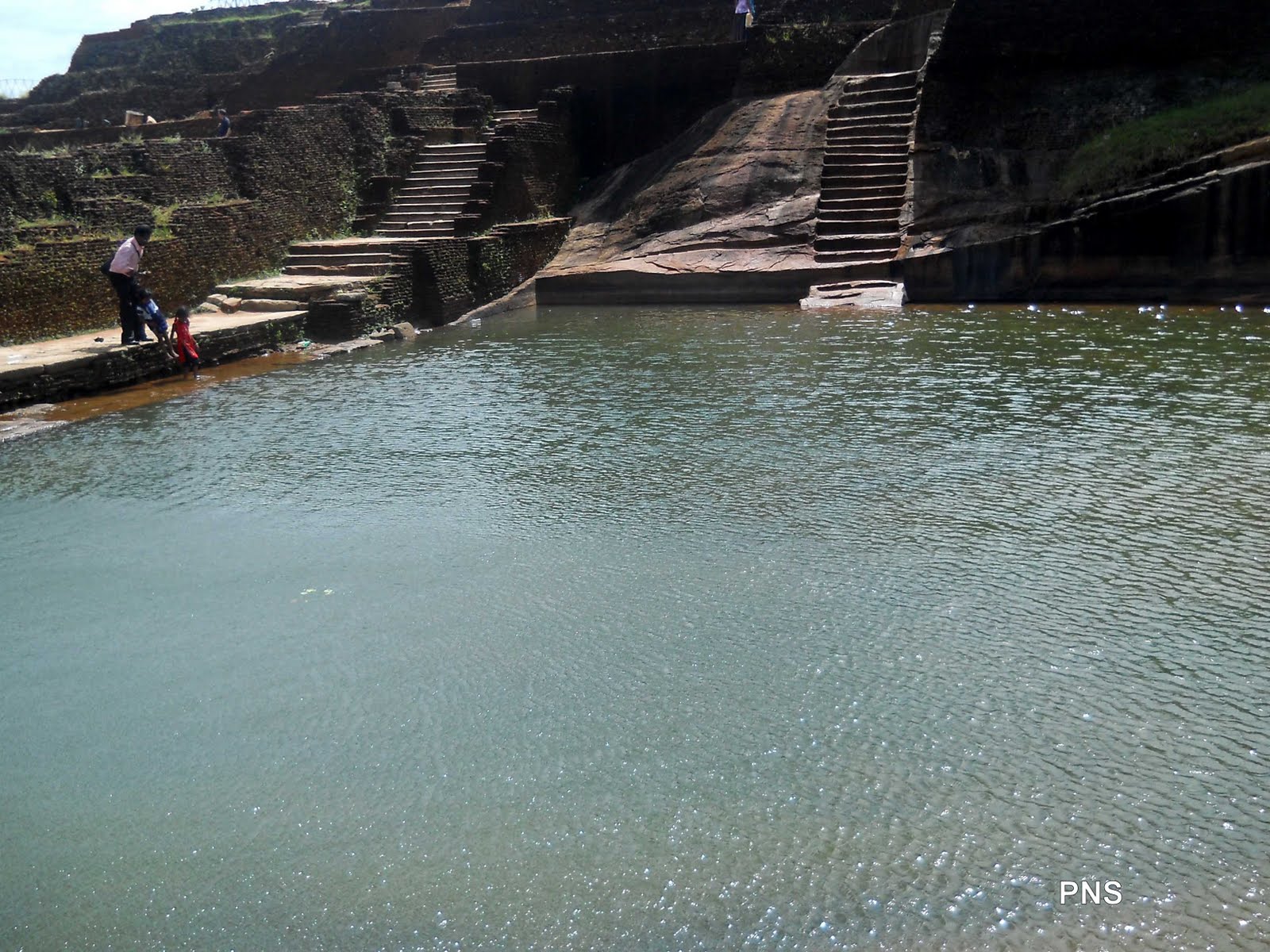
Pool at the summit
King's Assembly area
A throne at the summit beside the pool
At the summit an archaeology enthusiast can spend hours looking at astonishing features of such an architectural wonder. The remnants of the swimming-pool, pools providing drinking water and pipes leading off from them are still visible. Meeting places, stone seats, courts and sentry posts are nearby.
 
View from the summit
Farm Lands
We stood there admiring the surroundings, looking at the dense forest on the one side which would have been hunting place for the kings in search of wild elephants to be used in wars and the far reaching fertile paddy fields on the other side which provided them abundant wealth of grains. Somewhere beyond those fields in the north is Anuradhapura, King Kashyap’s birth place. Towards East, 80 miles away is the famous Trincomalee, one of the most beautiful harbours in the world. And in the south-west about 100 miles away is our temporary base in Srilanka. We had to leave as it was already 5 pm in the evening. Sayonara Sigiriya ....