Web Analytics

Thursday, July 12, 2012

Jamia Masjid (Mosque) - Srinagar


After having visited Hazratbal, we thought of going to the Jamia Masjid (Mosque) at Srinagar. However, our driver had some reservations. He informed that the Mosque is at the centre of the old part of the city and is a disturbed area. Cannot be considered to be very safe. Then he remembered that it was a Thursday and not a Friday. Fridays are special  when the area is fully crowded for the prayers at the Mosque. (Before I could make out a post, there was a news that a 300 year old “Dastagir Sahib”a holy shrine of the Sufi order, went into flames under mysterious circumstances. To contain the violence that followed, curfew has been clamped through out Kashmir. Even people have been restrained from offering their Friday prayers at Jamia Mosque on the 29th June) Therefore the driver obliged us and took us through the streets of the old city. From an otherwise thinly populated areas we were proceeding  towards high density area. 


The houses and buildings on our way  had a an old world charm and we could not resist clicking our cameras. Soon we noticed a tall tower at a distance resembling that of a church but then our driver corrected us saying that it is the Jamia Masjid.


We were now crossing a main road to go down. The mosque was at a lower elevation and now it was in full view. The main entrance is from the Southern side. The mosque seems to have had entrances from North and East as well. There is a broad lane surrounding the mosque with show rooms and shops on one side stocking items ranging from cloth, utensils, handicrafts and other domestic needs. It is said that the market here is cheaper as they primarily cater to the needs of the local population.


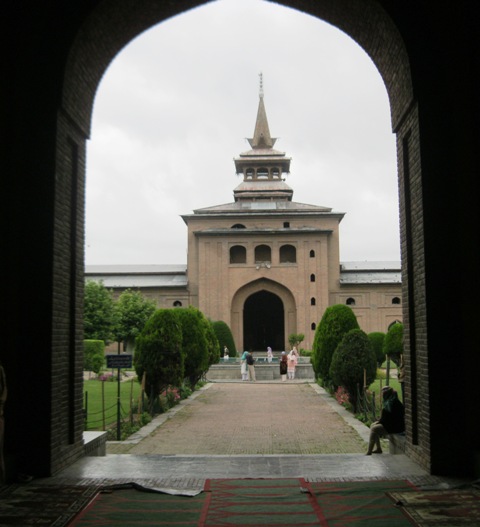
The arched doorway is huge but then the pagoda type superstructure  resembles that of a Buddhist shrine. There are no domes and minarets which we generally find associated with mosques. Practically all mosques in Kashmir are devoid of domes. The mosque is supposed to be a unique representation of the Indo-Saracenic architecture.


On entering through the main doorway, we find a magnificent square courtyard with well maintained lawns and ornamental trees. Towards the West is the main prayer hall wherefrom the Imam (Head Priest) directs the congregation. Just in front of the main prayer area there is a large square pool with flowing water used for ritual washing of hands before entering the hall for praying. There is a LED display board inside which shows the exact timings for the 5 times a day  prayers. This main complex is surrounded by a very broad corridor on the other three sides with fully carpeted flooring.


The Jamia Masjid is located in the Nowhata area of Srinagar. This was got constructed by the local ruler Sultan Sikandar in the year 1400. Later extensions were carried out by his son Jain-ul-Abidin. As said earlier the architecture is of Indo-Saracenic type. As a matter of fact it is an amalgam of Gothic, Mughal and Indian styles. Here they have used fully baked bricks for the whole construction. It has a wooden ceiling over which corrugated tin sheets have been placed angularly to facilitate easy clearance of snow during winters. the ceiling is supported by 370 very tall pillars made of pine timber. The mosque has a capacity to accommodate a congregation of 33333 people under its roof. Unfortunately this mosque too had to suffer great amount of loss due to fire which broke out at least thrice so far. The last renovation after a major fire was carried out by a Hindu ruler Maharaja Pratap Singh during the later part of 16th century.

Amongst all the mosques we have seen in India, this one is unique and justly called the pride of Srinagar.

Hazratbal (Srinagar)


Very close to the Nishat Baug at Srinagar there is a very famous place known as Hazratbal. Once it was a village which now is a suburban locality of Srinagar. “Bal” literally means  a place and it is some times misconstrued as “Baal” meaning “hair”. Hazratbal if literally translated could mean a holy place. Interestingly it does have an association with the  “hair” of the Prophet Mohammed, the precursor of Islam. It is believed by the muslim community of Kashmir that a strand of hair from Prophets beard is preserved at a shrine thereat which is also referred to as Hazratbal. A gang of terrorists even occupied the shrine with an intent to take away the holy relic and in the shoot out that followed, the security forces succeeded in eliminating them. Even thereafter there had been few skirmishes. Now it seems that peace has finally dawned. There are hundreds of pigeons here and people say that the white ones, representing peace, are on an increase. Because the entire area is sensitive, security forces have been posted at the shrine.

The structure as it appeared in 1920
The holy relic gets exposed to public view five times a day for the whole week during during Eid-e-milad and Meraj-un-nabi celebrations. Thousands throng to this shrine during those occasions just to have a glimpse of the relic. It is said that during the beginning of the 17th century a high official of Shahjahan’s court got constructed a beautiful building (Isshrat Mahal) with gardens spread out. In those days the surrounding area was known as Sadiqabad. When Shahjahan visited the place in 1634 he ordered the building to be used as a prayer hall. Historians are of the view that the relic was brought to India from Medina by one Syed Abdulla a descendant of the Prophet, who settled down at Bijapur in Karnataka. After his death the relic came into the possession of his son Syed Hamid. But then the area came under the attack of Mughals who annexed it. During the turmoil, Syed Hamid lost all his properties and was not able to take care of the family relic. He, therefore, sold it to a rich Kashmiri merchant named Khwaja Nur-ud-din Eshai. When Aurangazeb (Mughal emperor) came to know about this, he got the holy relic confiscated and sent it to the shrine of Khwaja Moinuddin Chishti at Ajmer. Nur-ud-din Eshai was arrested for possessing the relic and jailed at Lahore (now in Pakistan). It seems that after some time Aurangazeb’s conscience deplored his own actions and then he decided to return the relic to it’s owner Nur-ud-din and set him free. However by that time Nur-ud-din, while in jail,  had already departed to his heavenly abode.

It was in 1699 that the remains of Nur-ud-din Eshai’s body as also the holy relic were brought to Kashmir. Inayat Begam, daughter of Nur-ud-din got the remains of her father’s body cremated and a shrine erected at Hazratbal. She also took the holy relic under her protection. The present structure made of marble was constructed by the Muslim Aukaf Trust administered by Sheikh Abdulla (a renowned politician of yester years). The construction started in 1968 and got completed in 1979. The shrine, apart from religious activities, was also a nerve centre of all political activities at Srinagar. Sheikh Abdulla used to address the public from this venue and became very popular. After his death, his son Dr. Farooq Abdulla desired to have  control over the affairs of the shrine but terrorists had a upper hand from 1990 onwards. The shrine proved to be a safe heaven for them.


We roamed about the residential areas adjoining the Shrine and then proceeded towards the left. The road was going down, not steep though. To our right there was one opening leading towards the left side of the Holy Shrine. Amidst a well laid our lawn, there were some ornamental trees.  The main dome of the shrine had scaffoldings and it appeared that some restoration/repairs were being undertaken. There was a group of Kashmiri women at the extreme end of the lawn singing and rejoicing. We asked a gentleman there, probably belonging to that group, about the happenings. We were told that a family from a nearby village had no issues and they had prayed at the Shrine earlier. As a result a baby was born and that the family has brought the child here and were expressing their gratitude. We sought their permission to take few photographs and they gladly agreed. After enjoying their traditional group song with the accompaniments, we proceeded towards the shrine. There were not many tourists. Most of the people there were local women who were entering a side hall to offer their prayers. We had a peep through a window. When we were proceeding towards the front side, we encountered few security personnel. We once again enquired if it would be proper for us to take photographs. We were advised not to do so inside the hall leading to the main Shrine (tomb). There was a covered porch outside through which we could enter the main hall, The hall was fully decorated and carpeted and looked like the hall of a church without the seating arrangement (benches). Thereafter we came out and we were on the main street after passing through an arched gate.


The visitors from different parts of country generally  pay a visit to the shrine. In the past, even the political delegations, including from the BJP, also made it a point in the past to pay obeisance at the shrine. Former prime ministers Indira Gandhi and Atal Behari Vajpayee, and Presidents Neelam Sanjiva Reddy and APJ Kalam had also visited the shrine. But now a days It seems that tourists are not very comfortable coming here as it is perceived that any thing could happen anytime.


Here is a small video:


Thursday, July 5, 2012

Nishat Bagh and Harwan Garden (Srinagar)


After having spent about 2 hours at Chashme Shahi we had to return taking the same road via the Governor’s residence (Raj Bhawan). The second largest  Mughal garden known as Nishat Bagh was again located on the main road on the  Eastern bank of Dal Lake with the same Zabarwan mountain ranges as its backdrop. The waters flowing out of the garden has been made to slide down from about 15 feet high into a rectangular pool by the side of the road.


Once upon a time the waters straight away  fell into the lake but now there is the road in between. Nishat Bagh literally means a garden of joy or merriment which was got created by Asif Khan the brother of Noor Jehan (Mughal Empress) in the year 1633. It is rectangular in shape running some 1800 feet towards the mountains with a width of over 1100 feet.  The mountain slope has 12 terraces, representing the Zodiacal signs. There is a mountain spring at the top which has been made to flow down through water channels built with polished stone. There are pools on every segment of the terrace with beautiful fountains. The entire length of the water channel also has fountains at regular intervals.


There was a large crowd at the ticket counter and almost all of them were Indians. We too joined them and after getting our tickets we could gain entry. At the far end there were large Chinar and Cypress trees. Their number seems to have dwindled and instead a new variety of flowering trees have come up whith a lotus like large fragrant white flowers identified as “Magnolia Grandiflora”. They are known as “Him Champa” in Hindi.


The long water channel with pools and fountains and flower beds were really a feast to our eyes. Our group members were not very much inclined to explore all the terraces fully as it seemed that their earlier visit to Chasme Shahi was very much fulfilling. In fact the upper reaches are said to be much more beautiful. However, the group as a whole was not keen to invest more time here and wanted to move to other destinations. It was some thing like a kind of  dictatorship of the proletariat. The majority had the say.

After having visited Nishat Bagh we were to visit Shalimar Gardens as per schedule but before we could take our seats in our vehicles the group members started shouting in unison. The question was what is going to be there except the same flora and fauna. Sensing disinclination to visit Shalimar Gardens, our driver said “well I shall take you to a place which is different and  not visited by any one except the locals”. It was again a garden, couple of decades old and not centuries. The location of Harwan garden was  beneath a dam.


By the time we reached there and came out of the vehicles, it was drizzling. We procured our entry tickets and got in. We realized after our entry that what the driver was suggesting was nevertheless true. There were no outsiders there excepting ourselves and it looked as if this garden is reserved for Kashmiris. Interestingly we could not come across any of the locals in the two gardens we visited earlier as if they have developed a kind of apathy for them. May be they needed seclusion but here we are clearly encroaching upon their territory.


The garden has neat pathways with arched gates. There were climbing roses adoring the arches in full bloom and looked heavenly. The waters from the dam ran through a deep channel on one side passing through several  age old shady Chinar  trees. However the leaves resembled a Maple. The greenery all around captivated us. Several school children were on a visit that day. There were many girls sitting under a Chinar tree and singing together. Some Kashmiri families were also enjoying their picnic  lunch.


It was drizzling but unmindful of our getting wet we climbed up the dam and could enjoy the beautiful view at the far end though it was a little foggy. The earthen slope of the dam also had a nursery of rose plants and some of them were also in bloom. Some school girls ventured to go inside to have a closer look at the flowers. We found that the girls were keen to have them photographed in their traditional attire. This facility was being provided by a photographer at the garden.


Yes it was a different experience and we had the satisfaction of having visited a place which is not frequented by tourists.

We were hungry and it was time for lunch too. We moved on and got down in front of a restaurant on the banks of Dal Lake. Our garden visits thus came to an end.

Friday, June 29, 2012

Gardens at Srinagar (Kashmir) – Chashme Shahi


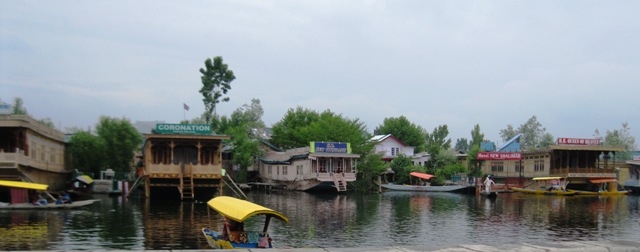
Until the recent past, we had all wooden bridges over rivers, rivulets and canals which got dismantled and replaced with concrete ones. The highway to Jammu is getting widened and a railway line is fast coming up. We shall see a direct train service from Srinagar within 2 years. The number of tourists visiting Kashmir this year is  phenomenal and all past records got broken. We do not have beggary as such but there are few who, to remain lazy, avoid working and solicit alms. This was what our driver had to share with us enthusiastically. He was taking us for a local tour of Srinagar. We were passing through the narrow strip of the extensive Dal Lake, a little early in the morning. On the other bank of the lake we could see many of the house boats in a row and few shikaras (roofed boats) floating around. The road we were taking is referred to as the Marine Drive locally which offers an excellent view of the lake for the whole distance. Roads and the footpaths were exceptionally clean.


Shalimar, Chashme Shahi and Nishat are the names of the major parks at Srinagar which are all Mughal Gardens. All of them are located on the Eastern banks of the Dal Lake with a shore line of over 15 kilometres. On the rear side, there is the  Zabarwan mountain ranges with many springs that are the source of perennial water supply to the gardens below. The topography would have facilitated the development of these gardens, not only during the Mughal period but much much earlier. The city of Srinagar was founded by a king known as Pravarasena.


Before our vehicle could reach the tail end of the lake along with which the road went, our driver made a right turn on a road adjoining the Botanical Gardens and told us that we are approaching the Governor’s residence. The security positioned on the road made all of us to climb down leaving behind children. The vehicle moved on and we made our way on foot to catch our car at a distance. We could not understand the purpose of this exercise, may be security considerations. After a short distance from that point the famous Chashme Shahi stood before us. The same road leads to another place known as Pari Mahal which was a Buddhist Vihara once upon a time.

We were required to buy tickets for entry into this park, There were tourists from all parts of the country but strangely no foreigners. Kashmiri folk lore attributes the discovery of the natural spring to a women saint named ‘Rupa Bhawani’. Her family name or nick name was ‘Sahibi’ and therefore the spring waters came to be known as ‘Chashme Sahibi’. Over a period of time the name got corrupted and  is now known as ‘Chashme Shahi’. Shahi stands for being Royal. However the garden around the spring was developed in a systematic way at the instance of Ali Mardan, a Governor of the Mughals in that region.


The outlet of the spring waters has been encased in a small structure and the waters fall in a square shallow tank and from here  the water channel facilitates further flow downwards. There were many who were queuing up to have some mouthfuls of the spring water which is said to have medicinal properties. Some say it cures many kinds of stomach ailments. Normally spring water from the mountains is considered to contain minerals and supposed to be pure. Medicinal and/or magical attributions are simply an exaggerated view point. We also struggled our way to the spot wherefrom waters flowed out and filled couple of bottles. Definitely the water was much superior to the ones we buy (processed and bottled).


This is the rear view of the main entrance

The mountain slope seems to have been levelled up in three tiers (terraced) for the development of a beautiful garden. There are Chinar and Cypress trees at the far end. Some exotic flowering trees have also been spotted. The flower beds have seasonal flowers in bloom. Roses have been grown extensively but looking to the grandeur of the garden, the varieties available (4/5) seem to be inadequate. However, the blooms and greenery all around was very soothing and captivated us.

The crowd here is to get them photographed in the traditional attire


Interestingly, the gardeners  were offering the seeds of the seasonal flowers of all shades at a high price.