Web Analytics

Wednesday, September 14, 2011

Sigiriya (Sri Lanka), A Palace in the Sky

A Guest Post by:
P.N. Sampath Kumar,
                                  Cochin Shipyard, Kochi                                  


I heard of Sigiriya, the historical monument in Srilanka for the first time while surfing internet in 2004 when my colleague in the office entrusted me with the job of planning his vacation in Srilanka. Considering the risk of travelling too much deep into that country due to the turbulent political situation and also the difficulty in climbing the number of steps for his ailing wife prompted him to opt out that option. But those inputs initially saw the seeds of curiosity and longing to visit this place at an opportune time.

Magestic Sigiriya Rock
For SriLankans “Sigiriya” is more than what our Taj Mahal is for us. Derived from the root Sanskrit name Sinha Giri (meaning Lion Mountain) this city used to be the capital of the 5th century King “Kashyapa”(479 – 497 AD). The Story goes that King Kashyapa, the son of Dhatusena (King of Anuradhapura – 50 KM north of Sigiriya) and half brother of Prince Moggallana killed his father fearing that his half brother would be appointed as the next king. He shifted his capital from Anuradhapura to Sigiriya and created this beautiful city in a span of, they say, 7 years. Sigiriya provided an ideal place for a fortress as it was in a difficult-to-approach remote area. His half brother Dhatusena though fled to India fearing for his life, came back stronger after few years and defeated his brother Kashyapa in a war. It is said that Kashyapa committed suicide by cutting himself, not wishing to die at enemy’s hand. The site became a monastic refuge after his death. In the 16th and 17th centuries, it served as an outpost of the Kandyan kingdom but later went into ruin and was rediscovered by a British archaeologist Mr. H.C.P. Bell.
 
All these in the backdrop of my mind, we included this site in our itinerary during our vacation to Srilanka in mid April 2011. We were staying in Kandy, in central Srilanka. It was a Sunday morning, after breakfast (we came across a couple of south Indian restaurants run by Tamils in Kandy) we proceeded to Sigiriya by a hired cab on a one day trip. Our Driver ‘Tamura’ from ‘Kandy Cabs’ was a nice boy who understood little Tamil and English. As advised by Ms Shakuntala, the owner of the hotel where we stayed, we got sufficient sandwiches, flavoured milk packets and bottled water parcelled for the journey. Itinerary included visit to Dambulla cave temples also en-route.

Kandy has unpredictable weather. We feared rain en-route as it was playing hide and seek for the last two days in Kandy. After a few miles (it is all miles and yards in Srilanka) alongside the Mahaveli River, and later through the reserve forest, we reached Matale town. We took a break there to have a cup of Srilankan tea and later walk around the big goddess temple (Muthu Mari Amman) in the middle of the town. I was told that Mahatma Gandhi has once visited Matale in 1927 and laid foundation stone for one school here.
 
Mariamman Temple at Matale
We furthered our travel through paddy fields and coconut plantations. The journey through the unknown land was pleasant. Paddy fields are getting ready for sowing. Farmers ploughing the land with buffalows is a usual scene. Air smelled mud. Occasional scenes of houses resembled the Malabar Coast in India. The tiled houses there are the most suitable for the rainy whether. On both sides of the road, there were shops selling bananas, fruits and vegetables and tender coconuts. Tourism is becoming a serious business. It was nice to see big Banyan trees on both sides of the road. Thanks to the conscious effort on the part of the government. Banyan trees are great source of Oxygen and even prevent depletion of ozone layer, they say.

Huge Buddha at Dambulla base
Dambulla Caves - Outside
The reclining Buddha
Buddha
Mural
Mural
Dambulla town is also the home for the most impressive cave temple in Asia, dedicated to Lord Buddha. Situated on top of a rock, the five caves are said to have been continuously occupied since it was established in 3rd Century BC. There is a functioning monastery. Dambulla is famous for murals, mostly Buddhist themes. They also run down below a good museum detailing the Jataka and other stories related to the Tooth Relic.
 
A Chaitya
Though entry for the Sri Lankans is free, foreigners including Indians are charged SL Rs.2200/- (1 SL Re= In Rs.0.45). Despite being funded by UNESCO, and liberally supported by Buddhist countries like Japan and Burma, they charge such huge fee from the foreign tourists. Elsewhere, in Srilanka, SAARC member country citizens are allowed 50% discount on entrance fee. (We availed this discount in Sigiriya and in Kandy Tooth Temple).

Dambulla is a lovers’ paradise too. Roadside shops selling lotus flowers, incense sticks, souvenirs and eatables are aplenty. On a whole, this place somehow did not impress me. This was my first encounter with a Budhist Shrine outside India. They have reduced it to being only a pilgrim centre, run by a group of ritualists catering to the needs of the poor locals.

Sigriya seen from Dambulla rocks
The view around Dambulla rock is enchanting. Sigiriya fortress seen at a distance of 13 miles was inviting us. In the next half an hours travelling through difficult village mud roads (the main road was under repair) we reached Sigiriya. SL Rs.1650/- was the ticket charge per person. We hired a certified guide (paid him SL Rs.500/-). We bought a bottle of cold water and followed our guide Perera. He gave us a very good brief introduction on the city of Sigiriya beginning from King Kashyap till the end.
 
Main entrance - A moat at the foreground
Old brick work
The city is about three kilometres in length and one kilometre in width surrounded by huge wall and an outer moat filled with water for added protection. Creatures like lizard monitors are in abundance. Their predecessors would have helped the intruders and thieves to climb the fort those days. A notice board cautioned the visitors against loud noise which could disturb the wasps on the big trees. Hornets attack is common here.
 
The water gardens
Experimenting with a fountain
The well-organised and landscaped gardens around Sigiriya consist of pleasure garden, water gardens, fountain gardens, boulder (stone) gardens and terraced gardens. The water garden, as it is called, particularly consisting of a number of symmetrical ponds and countless fountains on both sides of the main pathway welcomed us to the fort. Some of the fountains in the water gardens are still operable during rainy seasons. Our friend Perera demonstrated it by exhaling air into one of the holes to show water gushing out from the other fountain.
 
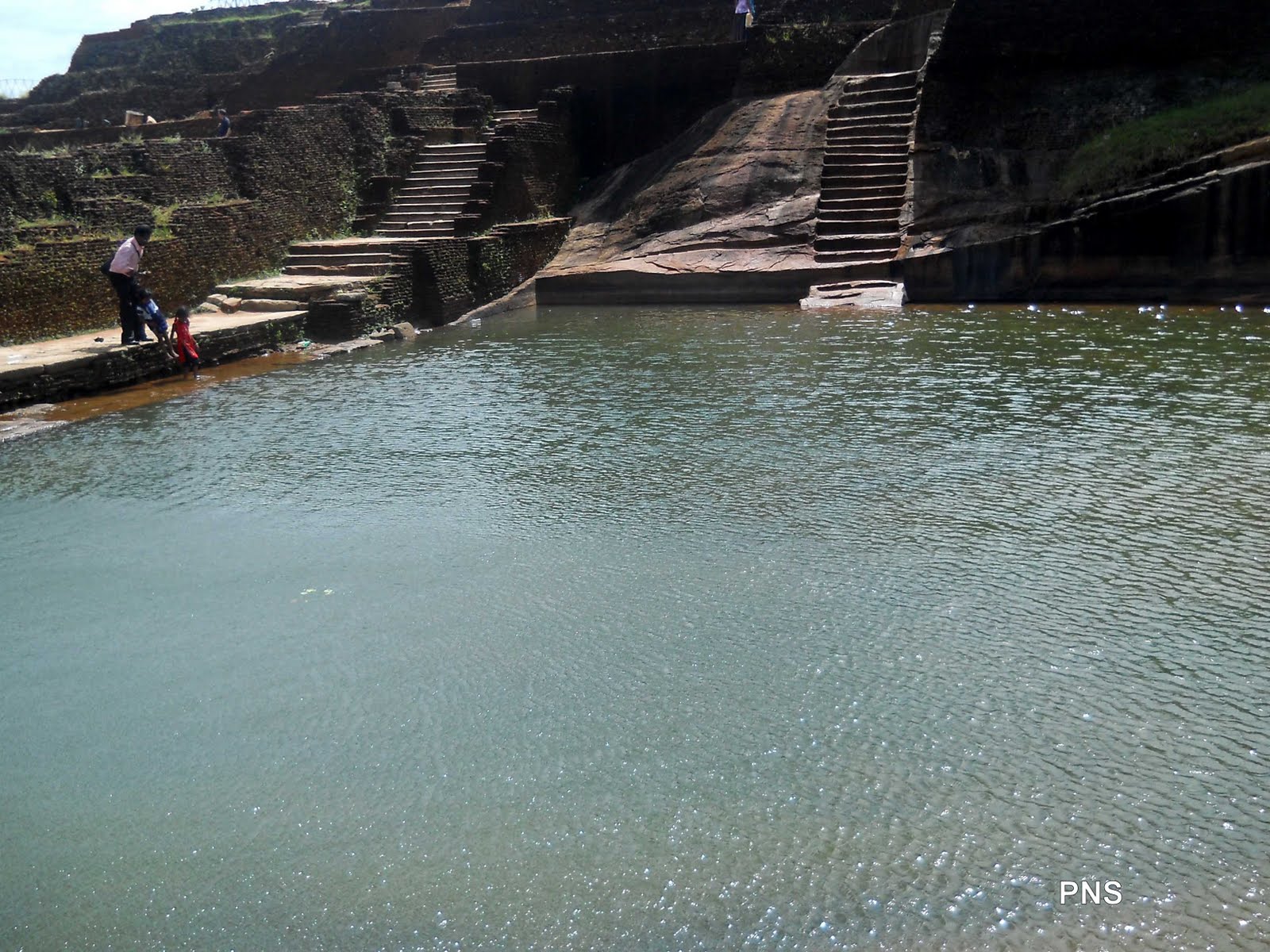
The king's summer palace was also located close to the water gardens, which are amazing constructions for those early ages. The gardens of Sigiriya are said to be the oldest such constructions in Asia and one of the first in the world. Excavations (by UNESCO) are still incomplete and a lot more need to be done.

Ruins of the Palace
The Lion Gate
Halfway through lion gate
The royal palace was built atop the rock while other buildings and gardens were built around the rock. Only the foundations of these structures remain now. At one time, a gigantic brick lion sat at one end of the rock while the climb to the top started with a stairway that led between the lion's paws and into its mouth. Although the lion is no longer there, the paws and the first steps are still visible. The stairway built around the rock leading to the summit is astounding.
 
The highlight of Sigiriya trip is the wall paintings (frescoes) of 5th Century AD period. From over 500 paintings only around a dozen paintings only are seen. Rest of it would have been destroyed by vandals or Budhist monks who would have thought that these paintings might distract them. These frescoes would remind one of the Ajanta cave paintings in India. Some believe the women depicted in these paintings to be ‘apsaras’. On a closer look, one can easily make out that these women were from different races. These beautiful women resembled, Indian, Chinese and even African faces. The quality and the bright colours speak volumes about the artists of bygone era and the techniques they used.

Graffitti on the mirror wall
A mirror wall beside the main stairway to the rock is another wonder. It is coated with a mirror-smooth glaze and continues to shine despite being exposed to rain, sun and winds for centuries. The graffiti on the wall is believed to have been written between the 6th and 14th centuries by the many visitors who were delighted by the splendor of the rock.
 
Pool at the summit
King's Assembly area
A throne at the summit beside the pool
At the summit an archaeology enthusiast can spend hours looking at astonishing features of such an architectural wonder. The remnants of the swimming-pool, pools providing drinking water and pipes leading off from them are still visible. Meeting places, stone seats, courts and sentry posts are nearby.
 
View from the summit
Farm Lands
We stood there admiring the surroundings, looking at the dense forest on the one side which would have been hunting place for the kings in search of wild elephants to be used in wars and the far reaching fertile paddy fields on the other side which provided them abundant wealth of grains. Somewhere beyond those fields in the north is Anuradhapura, King Kashyap’s birth place. Towards East, 80 miles away is the famous Trincomalee, one of the most beautiful harbours in the world. And in the south-west about 100 miles away is our temporary base in Srilanka. We had to leave as it was already 5 pm in the evening. Sayonara Sigiriya ....

Friday, September 2, 2011

Conch Shells : Fossils

Several years ago, I was told by one of my friends that he has inherited a solid (stone like) Conch Shell and that he is keen to let me have a look. Later on When I visited his place, he showed me his antique possessions over a cup of tea. Among other things, the solid Conch Shell was also present. I examined it and realized  that it was a million year old real fossilized Conch Shell. My friend was too happy to learn about it.  He had, however, no clue as to how it was sourced.

Once, when I was travelling in Shahpura area of Mandla District in Madhya Pradesh (India), I was informed that plant and tree fossils are scattered over a very wide area. Now it falls in Dindori District and has been protected as part of the National Fossil Park. The area forms a part of the great Vindhya/Satpura Mountain Ranges which divide India into North and South.


In an another occasion I was  traversing  the same terrain accompanied by a youth from that area. I questioned him if fossils of other living beings are also obtainable thereabout. He got enthused and offered  to take me on a hillock which according to him, had lot of things in store. We parked the vehicle at a convenient place and proceeded to scale the hillock known as “Karpa”. Karpa is also the name of the small town nearby. On the way and particularly on the summit, I was wonderstruck to find many boulders wherein fossilized Conch Shells were embedded. The rocks were fragile enough to be broken to take out the shells they encompassed. It was my GK (though poor) which suggested that the boulder rocks could have been formed  by the lava emitted during some volcanic eruption, millions of years ago. There could have been the Sea or a lake over there and the volcanic eruption created the hillock and brought up the Sea Shells which got deposited on the top of the hill. I collected few of them for my self and some more to serve as give a ways. I also brought along with me a piece of rock wherein the shell was in an embedded form.


According to the Hindu Mythology, when the Vindhya ranges started moving up (gaining height) it was feared that this could cause hindrance for the Sun (God) to move to the South. The assembly of Gods decided to entrust the problem to a Seer (Rishi) named Agastya. Agastya in turn accompanied by his family and disciples went up to the Vindhya Mountain and requested it to scale down its height to provide a passage to the South for his entourage. The mountain, in veneration, bowed down and assured to remain subdued till the return of the Seer from his journey to the South. However, the Seer was not to return and the mountain is keeping its promise.


While I was in service, these fossils served a wonderful purpose. I used to wrap them in a silver foil and present them to high dignitaries duly gift packed with a request to keep it in their prayer rooms. It was being emphasised to them that these fossilized shells will give them peace whenever they are troubled. They used to accept the gift  with great reverence, as Conch Shells, in Hindu faith are objects of that kind.
The story will begin again when somebody inherits them.

Sunday, August 21, 2011

A Little Brown Dove (Laughing Dove)

During September last year there was a strange visitor at home, a Viper, and we had to struggle hard to get it rescued. Fortunately there was a pleasant surprise few days back. Now there was a winged visitor.  A little brown dove, also known as Laughing Dove (Stigmatopelia senegalensis), flew in and refused to leave our home. Normally I used to spread some rice grains on the boundary wall and keep  water in a pot hanging by the branch of a Night flowering Jasmine tree (Nyctanthes arbor-tristis) also known as Parijat or Harsingar locally. Due to disturbances in the family after the demise of my wife, the practice of keeping feed for the birds could not be attended to.
. 


I have very many times observed a pair of the little doves flying around. On that particular day, a bag of rice was brought home and placed in a corner. It occurred to me that perhaps the dove has come in search of food or may be to complain that I am not keeping the feed for them outside.  Although I loved its intrusion, I was trying to drive it out lest it gets caught by the moving ceiling fans and injures itself. My fears really came true and it fell on the rice bag. We could easily catch it although it tried to escape by occupying its position on the curtain rods at home.We examined it and found that there were no external wounds, may be internally it could have been hurt some where. We released it in the garden and gave some water in a bowl.  it sat there for few minutes and then flew away. 


This incident was haunting me perpetually and I was always in the look out of this pair in our vicinity.  Now I am happy that they have been spotted and they are on their rounds. I am envious of my neighbour as the pair of the little brown doves have started building a nest in his house, that too adjacent to the electricity meter.

Thursday, August 4, 2011

A College in disguise

.We were returning from a visit to a knitwear factory at Tiruppur near Coimbatore. While we were about 10/12 kilometres away from our destination, a ship like structure became visible from a distance. My nephew who too was attracted, started shouting ship, ship. I protested, no It can’t be a ship, you don’t have a Sea here. He was not to be subdued. He promptly said, the Tsunami might have brought it here. Again I asked, then where is the Sea. He readily answered,  it was taken away by the Tsunami.

I took a photograph from that distance and when we were closing in, I got the vehicle stopped for further exploration. The structure turned out to be a College of Marine Engineering of Coimbatore. The photographs are appended.


Wednesday, July 27, 2011

Maple Leaved Bayur Tree

Very recently I was staying with my brother at Coimbatore. I spent a fortnight at his Race Course Road residence. On the very first day, after dinner, I was walking around the colony, just to have a feel. After walking down about 100 feet, I started getting a very pleasant sweet smell in the air. Soon my nostrils got filled with that fragrance. Soon I could discover the tree laden with beautiful flowers which was emanating that queer smell. I would have attempted to take a photograph to capture the bloom, though I knew the built in flash was not adequate to get a good shot. Therefore I decided to return in the morning. When I reached the tree the next day morning, I was totally disappointed for all the flowers were lying on the ground. I understood that they are nocturnal in nature. Some how I could locate one which was still clinging to the branch as if to oblige me. I lost no time and could get a reasonably good picture after zooming in.


The white flower is quite large and with which I was not acquainted with. I asked the watchman guarding the gate about its name. He said it is “Venangu” in Tamil. Thereafter I consulted with my knowledgeable friends over telephone but none could help me to augment my own knowledge. I was also lacking the facility of transmitting the photograph over the mobile (Cell) phone.

When I reached Chennai I continued my exploration. Some amount of googling (flowers of India site) helped me to resolve the problem of identification.  It was the Maple leaved Bayur Tree (Pterospermum acerifolium). Incidentally it is a native of India and Myanmar. In Hindi it is known as Kanak Champa, Muchkund or Padm Pushp. In Bengali it is Rosukunda. In Sikkim it is known as Hathipaila. The tree has red wood which is used to make planks.

Thursday, June 16, 2011

Chennai Crocodile Bank

During the month of April this year, I happened to be at Chennai (Madras). One day my extended family members evinced interest to visit Mahabalipuram (A World Heritage Site) and wanted me to show them around. I readily accepted for they believed in my  credibility  to be their guide. While proceeding to Mahabalipuram, after travelling 45 kilometres, there is the Madras Crocodile Bank. Since I could not visit this place earlier, I decided  to make a short break thereat. We parked our vehicle at the parking slot and entered the sanctuary after buying our tickets.

There was a time when the crocodile population in India was dwindling. Some feared that they may also become species near  extinction. With a view to protect and conserve crocodiles, alligators and other reptiles this farm was established way back in 1976. Incidentally this is a private initiative and not by the Government. The credit goes to Romulus Whitaker, the famous herpetologist, who was instrumental in its establishment along with few like minded friends.


To begin with some 30 crocodiles were brought here and due to the conservation efforts the population is now around 5000. Perhaps now it is going to be a problem of plenty.  Apart from the Indian species of Crocodiles and Alligators, their cousins from around the world have been brought in. However they seem to enjoy better and spacious surroundings as compared to their Indian counter parts. This centre is claimed to be largest zoo of such reptiles in the whole world.

Incidentally the water bodies as also the whole place stinks and one has to  muster a lot of endurance to withstand. While searching for an answer I found the place has very many big shady trees and thousands of cranes have made them their home. Their droppings are the reasons behind the problem. While visiting this place one needs to wear a cap or cover the head for protection.  

As is well known, India is also a home for venomous snakes. There is a community in Tamilnadu known as “Irulas” who are very skilled in catching venomous snakes. To conserve their art and provide them a kind of livelihood, Mr. Whitaker got them united and formed a Cooperative Society. They have a separate enclosure in the sanctuary where they regularly bring the snakes and and keep them in pots.  They extract the venom which costs anywhere between Rs.1000 to Rs.5000 per gm. Visitors are also shown the process involved.