Web Analytics

Friday, June 29, 2012

Gardens at Srinagar (Kashmir) – Chashme Shahi


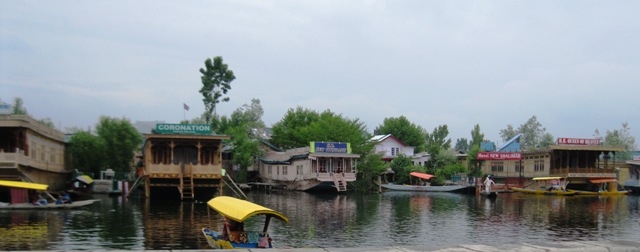
Until the recent past, we had all wooden bridges over rivers, rivulets and canals which got dismantled and replaced with concrete ones. The highway to Jammu is getting widened and a railway line is fast coming up. We shall see a direct train service from Srinagar within 2 years. The number of tourists visiting Kashmir this year is  phenomenal and all past records got broken. We do not have beggary as such but there are few who, to remain lazy, avoid working and solicit alms. This was what our driver had to share with us enthusiastically. He was taking us for a local tour of Srinagar. We were passing through the narrow strip of the extensive Dal Lake, a little early in the morning. On the other bank of the lake we could see many of the house boats in a row and few shikaras (roofed boats) floating around. The road we were taking is referred to as the Marine Drive locally which offers an excellent view of the lake for the whole distance. Roads and the footpaths were exceptionally clean.


Shalimar, Chashme Shahi and Nishat are the names of the major parks at Srinagar which are all Mughal Gardens. All of them are located on the Eastern banks of the Dal Lake with a shore line of over 15 kilometres. On the rear side, there is the  Zabarwan mountain ranges with many springs that are the source of perennial water supply to the gardens below. The topography would have facilitated the development of these gardens, not only during the Mughal period but much much earlier. The city of Srinagar was founded by a king known as Pravarasena.


Before our vehicle could reach the tail end of the lake along with which the road went, our driver made a right turn on a road adjoining the Botanical Gardens and told us that we are approaching the Governor’s residence. The security positioned on the road made all of us to climb down leaving behind children. The vehicle moved on and we made our way on foot to catch our car at a distance. We could not understand the purpose of this exercise, may be security considerations. After a short distance from that point the famous Chashme Shahi stood before us. The same road leads to another place known as Pari Mahal which was a Buddhist Vihara once upon a time.

We were required to buy tickets for entry into this park, There were tourists from all parts of the country but strangely no foreigners. Kashmiri folk lore attributes the discovery of the natural spring to a women saint named ‘Rupa Bhawani’. Her family name or nick name was ‘Sahibi’ and therefore the spring waters came to be known as ‘Chashme Sahibi’. Over a period of time the name got corrupted and  is now known as ‘Chashme Shahi’. Shahi stands for being Royal. However the garden around the spring was developed in a systematic way at the instance of Ali Mardan, a Governor of the Mughals in that region.


The outlet of the spring waters has been encased in a small structure and the waters fall in a square shallow tank and from here  the water channel facilitates further flow downwards. There were many who were queuing up to have some mouthfuls of the spring water which is said to have medicinal properties. Some say it cures many kinds of stomach ailments. Normally spring water from the mountains is considered to contain minerals and supposed to be pure. Medicinal and/or magical attributions are simply an exaggerated view point. We also struggled our way to the spot wherefrom waters flowed out and filled couple of bottles. Definitely the water was much superior to the ones we buy (processed and bottled).


This is the rear view of the main entrance

The mountain slope seems to have been levelled up in three tiers (terraced) for the development of a beautiful garden. There are Chinar and Cypress trees at the far end. Some exotic flowering trees have also been spotted. The flower beds have seasonal flowers in bloom. Roses have been grown extensively but looking to the grandeur of the garden, the varieties available (4/5) seem to be inadequate. However, the blooms and greenery all around was very soothing and captivated us.

The crowd here is to get them photographed in the traditional attire


Interestingly, the gardeners  were offering the seeds of the seasonal flowers of all shades at a high price.  

Saturday, June 23, 2012

Kashmir - a dream comes true


We have been looking forward for an opportunity to visit the northern part of India called Jammu & Kashmir. However, militant activities thereat prevented us from risking ourselves for decades. Now that peace seems to have been restored a suggestion from a friend encouraged us. We decided to go in a group of 10. We had to decide upon the mode of conveyance. There are regular flights from New Delhi to Srinagar but the fares seemed to be prohibitive. Therefore we ended up booking ourselves with a reliable tour operator at Srinagar and surrendered to him for the week long itinerary.

Our actual journey began by train from Bhopal to Jammu Tawi on the 5th June morning. After over 24 hours we were at Jammu the next day morning around 10.30 AM. We had a very nice time for having had the company of a cute little friend and his frolics.
Two vehicles were already positioned there at the Jammu Railway Station to take us onwards to Srinagar which is at a distance of 300 kilometres. Jammu station seems to be built on a hillock because all the roads from there make you go down.

Jammu Railway Station


The journey by road was not all that pleasant although the vehicle was spacious and the terrain we traversed was picturesque. The vehicle was winding its way through the hills, sometimes going down to be very close to the Tawi river and some times going too up to catch the clouds. When we were happy to learn that  we were half through our journey, we were caught in a terrific traffic jam. Incidentally the vehicular traffic between Jammu and Srinagar is very high and domesticated buffalos have a right of way. 


Traffic moved inch by inch and after about 2 hours we were able to speed-up  to be caught in yet another jam. This time we came to see a dam in a beautiful surrounding where some eating joints existed. The dam is known as Baglihar. Hydel power is generated there. We had our fill and continued our journey.

After completing around 240 kilometres, it seemed as if we are in the plains. We were at a place known as Kazigund, a small town full of activity. There were plenty of restaurants around and we thought of finishing off our dinner there but some wanted to reach the hotel, we were booked in at Srinagar. Therefore we rang up the hotel management to arrange for our dinner past 10.30 PM.

Area surrounding our hotel
By the time we reached our destination, it was well past 11.00 PM with a delay of 3 hours.

This post is just a preamble. Subsequent posts will take your through the beautiful valley, glimpses of people and a peep into the culture. 

Tuesday, May 15, 2012

Mahabalipuram - Shore Temple


We had a stop over at Chennai while returning from our Kerala trip. One day my younger brother wanted to visit Mahabalipuram and I was happy to join him for it was many years ago that I visited the place. Incidentally I ought to tell that Mahabalipuram is around 60 kilometres South of Chennai on the way to Pudussery (Pondicherry). It was a bright sunlit day and quite warm under the Sun. In less than 2 hours we could reach Mahabalipuram which was earlier known as Mamallapuram.


We headed straight to the famous Shore Temple, known so, for it faces the Bay of Bengal and is just on the Shore. It is supposed to be one of the oldest structural temples of South India. 

I believe  a little bit of history could be tolerated. There was a great dynasty known as Pallavas who were ruling that area with their Head Quarters at Kanchipuram between the 3rd and 9th centuries CE. They were sea farers and Mahabalipuram was their main sea port,  for access to South East Asia as also Sri Lanka as evidenced by various artefacts/coins found thereat. One of the dynasty’s illustrious ruler Rajasimha Atyantakama (he had several titles) was reigning during the 7th century.Needless to say that he was a great conqueror and would have carried out several missions to expand his empire.   During that period Pallavas were   the strongest military power in the Sub Continent. Without going into controversies, we may conclude that the artisans would have been brought in from central/western parts of India where rock cut temple construction was in vogue. They were put to work at Mahabalipuram (we shall be speaking about the marvellous rock cut creations thereat in a separate post).


When we look at the Shore Temple from a distance they look like two pagodas but when we are in, we find three temples in a row. We were talking about the artisans/masons (not to be misconstrued for the free masons of the Masonic lodge!). To begin with they were instructed to carve out a Vishnu (reclining) shrine out of a monolith on the shore. They did their job well and their skills having been tested, were then assigned many other structures to be carved out at some distance.


The reclining Vishnu appears to have been the earliest creation as per a label inscription found on the lintel of this temple, calling it “Narapatisimha Pallava Vishnu Griham”. Narapatisimha is a title of Rajasimha. Then followed the construction of other two temples, but not immediately. It has probably been done after about 50 years  to appease the sentiments of a larger faction of Hindus who were staunch believers of Lord Shiva. Thus this is seen as a balancing act on the part of the royalty.   In the process Lord Vishnu got sandwiched between two shrines dedicated to Lord Shiva.


As said earlier, after carving out a Vishnu's (Reclining form known as Anantashayana) out of a megalith, two more shrines for Lord Shiva got constructed with dressed up granite stones. The smaller one in the front and a larger one at the back and in between sleeps our Lord Vishnu. Some suggest that the smaller one facing west was originally the mandapa (porch)  for entry  to Vishnu's shrine but we could not find any opening as such. However, the wall adores a Somaskanda (Shiva). Supposedly there was a Shiv Linga (Phallus) which is now missing.


The larger temple at the back (facing East) was not open that day. There is said to be a large (broken at the top) Shiv Linga with sixteen faces made of polished granite and also a Somaskanda on the wall identical to what we have seen at the smaller temple facing West. There are many other sculptures in and around the temple which have eroded to such an extent that  it is becoming difficult to identify them. We therefore, instead of spending time on that, decided to  go round and circumambulate the shrines.  We could discover the following three inscriptions which holds clues with regard to this complex..

This was probably  in the smaller Shiva Shrine


While moving clockwise, we figured an oval tank in the centre of which there was neat hole of about 8 inches with a clean cut slot to serve as a lock.  This is generally done to hold things securely. Probably a Shiv Linga was located there. But then there is a beautiful pillar quite tall looking like a Capstan of a ship just in front. We could not figure out what it is and with what  purpose. Since there is an opening on one side, we assumed that it could have been a very small shrine. The same tank also accommodates a rock cut damaged boar, an incarnation of Lord Vishnu.


Within the tank like structure, we also came across two sculptures, one seems to be that of Shiva on the Bull and the other one remained elusive.


While moving southward, we encountered a large seated lion which in itself was a shrine for Goddess Durga with an opening in its chest with a seated Durga.


Some other photographs relating to the site:

Such structural pieces remains scattered all around
This Ganesa is difficult to locate
While concluding it would be pertinent to add here that the site is supposed to have had 7 pagodas as stated by Marco Polo. 5 of them are supposedly swallowed by the Sea leaving the two, we now see. However deep water explorations by the ASI (Archaeological Survey of India) only reveal the existence of a wall stretching into the sea and no more than that. Of course some of the fragments of the existing structures do surface when the sea recedes.

Now we are moving towards other part of Mahabalipuram where the rock cut temples etc. await us. 

Friday, April 20, 2012

Chennai - Largest Bus Station


In one of my previous posts I covered the Asia’s largest Perishable Commodities Market at Koyambedu (Chennai) and now here comes the largest Bus Station in South Asia. Incidentally this is also there at Koyambdu and that too very close to where I was residing. It so happened that we were proceeding to visit the market and en-route I could catch a glimpse of a huge structure. It appeared as if a very large boat has been put upside down over a building. Needless to say that I enquired. I was told that it is the Bus Terminus. The driver seemed to be more enthusiastic. He said Sir, it is as big as an Air Port. Since we had driven quite far from it, I decided to have a see some time later. The opportunity came the same day evening.

It was just adjacent to  the SAF Games Village where I was putting up so I ventured to take a walk accompanied by my son, who had arrived that morning. Walking on the main road caused a little discomfort because of the construction activity of the Chennai Metro Project.  
The Bus station called Chennai Mufussil Bus Terminus (CMBT) is 500 yards inside from the road. The architecture of the front building  was some thing unique but there were several  sign boards and structures which were obstructing a clear view. The moment we entered the front hall,  we were confronted by the Security. This was never anticipated. May be we were questioned for we were not carrying any bag or baggage. That was good and admirable. We were overwhelmed to see a very huge hall with shining tiles on the floor and without any rubbish scattered. No doubt the premises have been kept very clean. The aesthetics of the  interiors of the passenger area has blended with the architectural design perfectly. We were not able to reconcile with such kind of a thing. The image of Bus Stands/Stations stored in our permanent memory failed to recognise this. This beauty was something  alien. But it was there!


We proceeded further to have an idea about the buses and the facilities thereat.All the facilities needed by passengers are in place. There were locker rooms where passengers can lodge their luggage, an ATM for drawing money, dormitories AC and non AC could be rented, eating joints, Coffee/Tea stalls, Magazines/News papers, wheel chairs for the disabled, a super market, clean toilets and what not. As our driver had commented, this just seemed to be an Air Port with all securities on alert.


The inner yard had several platforms. We took the first one which had around 33 bays for buses to enter. Most of them had buses waiting for departure. Every bay had indication boards in English and Tamil and the buses also displayed their destinations. It was really very easy even for a foreigner to identify the bay which could take him/her where ever one wished to go. Many of the buses we came across were long distance ones going to or coming from  different states. The platforms for destinations within the state were different. In all there were 6  platforms but we also saw buses stationed outside this area.


The Bus terminus has an area of some 36.5 acres (148,000 m2). We understand that the terminus handles around 500 buses at a time 3000 buses and 2,50,000 passengers a day. Really unbelievable. The parking space for vehicles seemed to be quite comfortable and then there is a double basement parking structure to accommodate nearly 3000 two wheelers.


We walked to the extreme end of the terminus and took a right turn which opens on the Kaliamman Street. All the buses go that way and there is a shaded pathway for pedestrians. From there we went to the junction  on the Jawaharlal Nehru Road and came to see an outlet of a renowned sweet shop. Could not resist buying some sweets for children at home. It was already dark by that time and while passing through the road, we could get a snap of the Bus terminus which looked beautiful when it was lit.


It was Mr. R Sudhir Kumar who actually made me to make out a post on this wonderful Bus Station. Sudhir is a wonderful photographer too and has a beautiful blog here.