Web Analytics
Showing posts with label Bhopal. Show all posts

Saturday, June 26, 2010

Foot Prints of Pre-historic Men around Bhopal


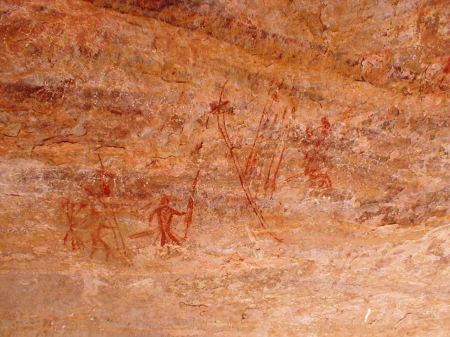
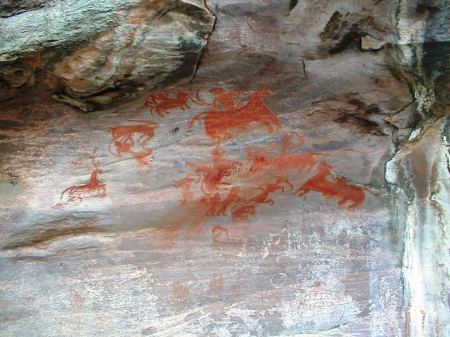
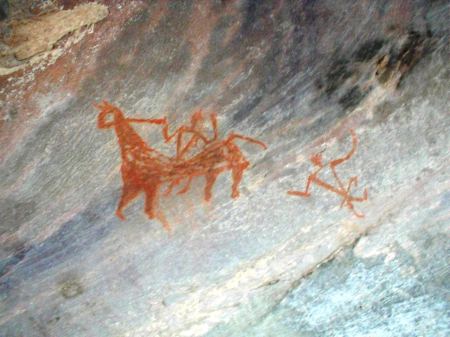
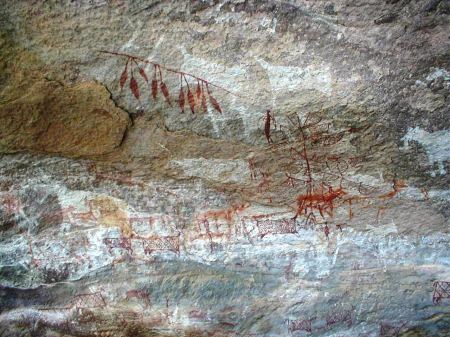
Foot prints of pre-historic civilizations are scattered all over the Indian Sub Continent but their abundance in Madhya Pradesh and Chhattisgarh is noteworthy. Rock Shelters and Cave Paintings at Bhimbetka near Bhopal are now world famous, thanks to UNESCO which has recognized them as a World Heritage site. Such paintings are known from Singhanpur (Kabra Hill) in Raigarh district, Adamgarh near Hoshangabad, in the nearby hills at Bijawar (Chhatarpur district), at Mrigendranath cave of Patni village of Bareli Tahsil (Raisen district),and again at Chidia Tol hills near Bhopal on Raisen Road. Very recently there were reports of rock paintings being destroyed in the mines near Budhni (Hoshangabad) and there was a great media cry. This prompted the administration to cancel the mining lease.

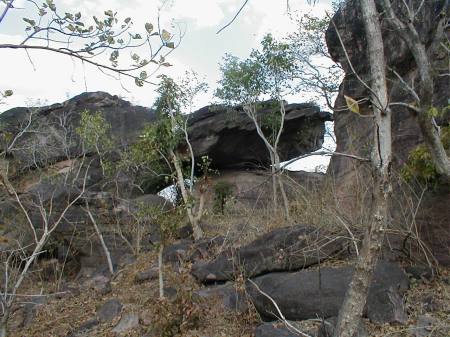
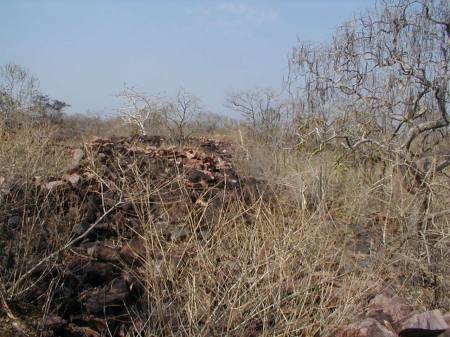
Closer to Bhimbetka at a distance of 5 kilometers there is another cluster of Rock Shelters known as Pengavan and the paintings occuring there are considered to be very rare. Their antiquity is between 10,000 to 35,000 years. It was also in the news that the hills running parallel to the Kolar Road of Bhopal also contain rock paintings. One Mr. Ashish Joshi, my neighbour, closely connected with the print media, happened to take us to yet another cluster of rock shelters which awaits to be discovered by an archaeologist of repute!. This is closer to the Kerva Dam where on a hill known as Ganesh Pahadi falling in the Samardha ranges, several rock shelters with beautiful paintings greeted us. Still farther from that spot at Madiakot, Mr.Joshi enthusiastically showed us a typical formation of a rock circle, believed to be the burial/sacred place akin to a Tumulus. It was around 70 meters in diameter. Very few people have noticed this so far and this is purely man made and not a creation of nature. A forest road through the newly developed picnic spot with tree houses would lead you there after traversing a distance of around 6/7 kilometers. However, one needs to have a jeep or bikes which can only carry you there.
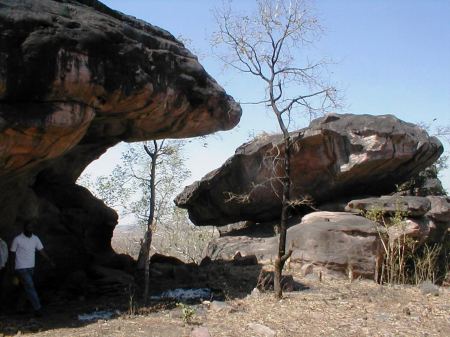
Once back at home, we also hunted for the stone circle for which Wikimapia and Google Earth came in handy. Yes the satellite maps clearly showed them. We were surprised to find one more small circle below (left) the larger one. It would be of interest to learn that the hills starting from Hoshangabad and going beyond Sanchi (North of Bhopal) have most of the rock shelters as also Buddhist Stupas. It is quite possible that the stone circles could have been the abandoned foundations of Stupas. We believe a deeper study of the terrain coupled with trial excavations is required to come to any meaningful conclusions.

The Eco Tourism Development Board of Madhya Pradesh has been hunting for such hidden treasures lying deep in the forests. For the past few years they are engaged in developing necessary infrastructure at such destinations so as to promote ecotourism. Close to Bhopal they have also identified Samardha village as their epicenter for extensive development. On the other hand the Forest Department, with a view to promote environmental awareness has constructed several tree houses and cottages close to the Kerva Dam near Bhopal. They also arrange trekking and mountaineering expeditions periodically. Incidentally ecotourism is not yet recognized as a forestry activity, although it is a means of conserving forests by increasing visitation and generating awareness. Under this umbrella, ecotourism can be a forestry activity, ancillary to conservation. For greater impetus the Government of India need to take steps to bring in suitable amendment to the Forest (Conservation) Act, 1980.

Wednesday, October 15, 2008

Satdhara - Buddhist Ruins

It is natural for friends and relatives visiting us expecting them to be taken around to places of interest. We have been religiously fulfilling this obligation to ensure that they also reciprocate , when we return the visit. This is a two way traffic. To give credence to their expectations, I have been visiting Sanchi, a world heritage Buddhist site, around 42 km's North of Bhopal, quite often. Whether I enjoy such visits is any body's guess. A Bhopal visit seems to be incomplete unless they go to Sanchi, to escape being ridiculed when they are back home.

My brother-in-law and his family was once on a visit to Bhopal. They wanted me to plan out visits to several places i.e., Ujjain, Dhar, Mandu, Onkareshwar, Maheshwar and of course Sanchi as well. I nearly fainted but it was a great relief when they requested me to arrange for a hired vehicle, large enough to carry all of us. I was spared of penning a requiem for my poor Maruti.


Within the next two days, we were on the wheels. As a first itinerary, we were on our journey to Sanchi. Many years ago I had heard that few more Stupas were discovered by the ASI (Archaeological Survey of India) somewhere near the present site. This information was lingering over my head. Before we could reach Salamatpur, short of about 12 km's from Sanchi, there appeared a hoarding on the left side of the road - "Satdhara - Buddhist remains - 5 km's". This was a new board with directions to the new site. Well I thought, this could be some thing of interest to me and worth exploring.


Since we were traveling in a hired vehicle (Sumo), I thought I could afford to ask the driver to take us that way. The driver obliged and took the narrow road towards Satdhara. Soon we discovered that the road was strewn with boulders, but we moved on, notwithstanding the fact that the journey seemed taking us to hell. The jerks were becoming unbearable and the distance was covered in about 1 hour!. By the time we reached the spot, tiredness was writ large on every one's face.


When we got down and looked around, we were dumb struck. There was a river flowing very very deep at the left, mountain ranges and greenery all around, the pristine beauty captivated all of us. Amidst thick forest cover, we could get the glimpses of the great Stupa in the wildest form one could imagine with all sorts of wild growth over it. We went closer and found restoration work being carried out. We could also see a second Stupa which was smaller in size. The area being large, we were contended with what we saw. Nobody, in our group, seemed interested in surveying the area any further. The spot, up above the river bank, was scenic and seemed to me as one of the most beautiful places for picnicking. The river is known as "Bes" and at some distance seven rivulets join the main stream and that is the reason for the place being known as Satdhara (Seven Streams).


Approach to the main StupaOn our way back from the main Stupa, I thought of talking to the officials at the site office. My interaction with them revealed that the Satdhara Hinayana Buddhist complex, is spread over in an area of 28 hectares, with a Main Stupa, twenty-nine stupas and two monasteries. The Main Stupa


was constructed in the third century BC, during the Ashokan period, with large-sized bricks. It was then covered with stone layers some four hundred years later. Fragments of northen black polished earthenware possibly from 500-200 BC and Buddhist rock paintings from the 4th and 7th centuries AD have also been found. However, not much is known about the relics stored inside the Stupas.


While returning, after a drive of about 2 km's, we cross a canal. On the right there stood an imposing relic of the Nawabi days. The place is known as Kachnaria Kothi. It was supposed to have been used by the Prince of Wales (George Vth) during his hunting expedition in the princely state of Bhopal during 1911/12. It is said that during his expedition not a single tiger could be located but the English News Papers carried reports of the prince killing 3 of them! Plans are afoot to renovate and develop it to promote tourism. We could not, however, visit the Kothi as it was locked. We then continued our journey to Sanchi as per the programme.

Photo middle one by: Srinath Rao                         Find a Hindi Version here