Web Analytics

Wednesday, July 7, 2010

Pit Elephants (കുഴി ആന)

This summer we were in Kerala  to participate in a family function. It was extremely humid and hot and there seemed to be no end to sweating and that too quite profusely, despite all the greenery. Kerala summers were never that harsh, thanks to Global Warming. 

Before dropping the Ant

After dropping an ant
One afternoon, I was just loitering around my  ancestral home. I came across some familiar soil formations on the sides of the pathway. Instantly my childhood memories came alive. They were the Sand Pit Traps laboriously created by “Ant Lions”, a term I have borrowed from wikipedia, but we knew that they are the abodes of “Kuzhi Ana” (കുഴി ആന) or literally “Pit Elephants” as they had  long noses. They are a bit different from the one wikipedia describes. The tiny, elephant like insect, used to position itself under the sand awaiting its prey which were usually the ants and other tiny insects. Myself and my sisters used to dig up the pits to catch the insects (Elephants!). Thereafter we used to amuse ourselves by organizing a race for those tiny creatures. Every one of us  used to shout to cheer up one’s own Elephant! as if we are in a horse race.   

.
Upon spotting the Sand Pit ant Traps, I could not resist the temptation of showing a live demonstration to children at home. They were summoned and a camera was brought in, an ant was caught and put in the hole. Lo! the ant just disappeared. The Antlion or our Pit Elephant living under the sand just dragged its prey in, in   a fraction of a second. There was only a depression in the cavity left behind. We could not, however, photograph that particular action. We should have applied the video mode instead.
http://www.youtube.com/watch?v=VvWsLrxTCQg

Saturday, June 26, 2010

Foot Prints of Pre-historic Men around Bhopal


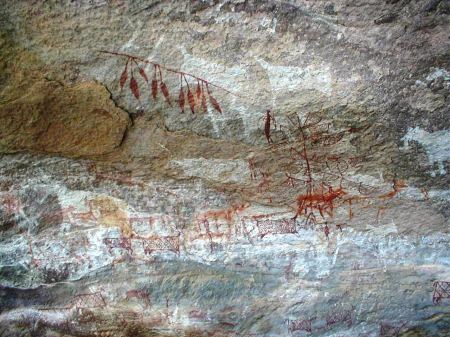
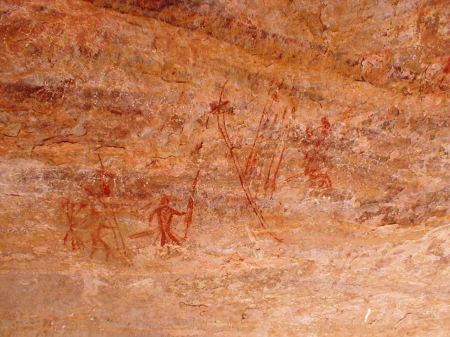
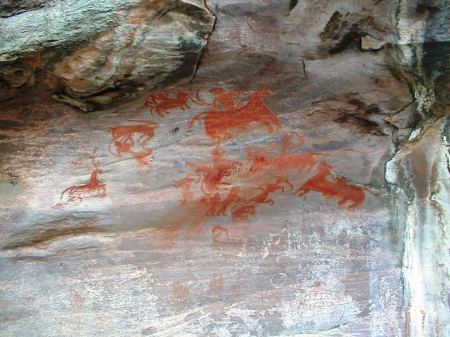
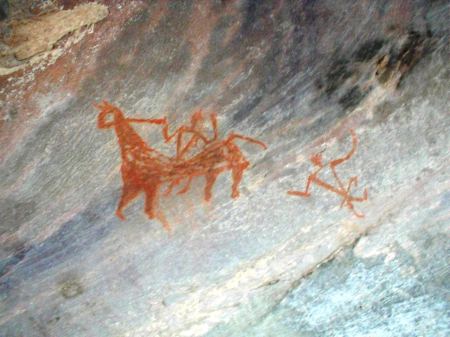
Foot prints of pre-historic civilizations are scattered all over the Indian Sub Continent but their abundance in Madhya Pradesh and Chhattisgarh is noteworthy. Rock Shelters and Cave Paintings at Bhimbetka near Bhopal are now world famous, thanks to UNESCO which has recognized them as a World Heritage site. Such paintings are known from Singhanpur (Kabra Hill) in Raigarh district, Adamgarh near Hoshangabad, in the nearby hills at Bijawar (Chhatarpur district), at Mrigendranath cave of Patni village of Bareli Tahsil (Raisen district),and again at Chidia Tol hills near Bhopal on Raisen Road. Very recently there were reports of rock paintings being destroyed in the mines near Budhni (Hoshangabad) and there was a great media cry. This prompted the administration to cancel the mining lease.

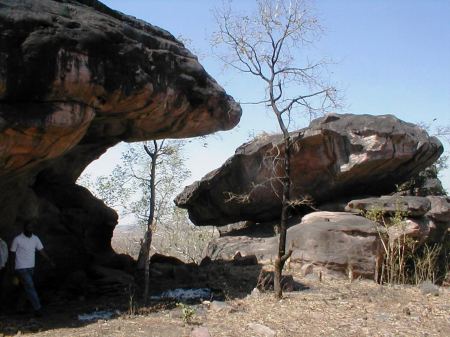
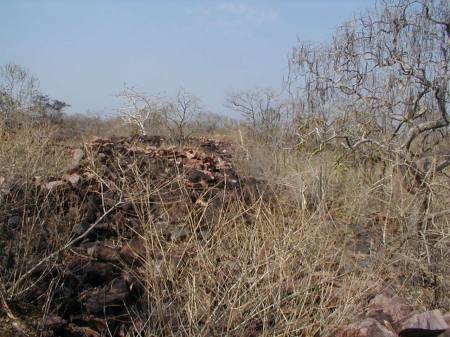
Closer to Bhimbetka at a distance of 5 kilometers there is another cluster of Rock Shelters known as Pengavan and the paintings occuring there are considered to be very rare. Their antiquity is between 10,000 to 35,000 years. It was also in the news that the hills running parallel to the Kolar Road of Bhopal also contain rock paintings. One Mr. Ashish Joshi, my neighbour, closely connected with the print media, happened to take us to yet another cluster of rock shelters which awaits to be discovered by an archaeologist of repute!. This is closer to the Kerva Dam where on a hill known as Ganesh Pahadi falling in the Samardha ranges, several rock shelters with beautiful paintings greeted us. Still farther from that spot at Madiakot, Mr.Joshi enthusiastically showed us a typical formation of a rock circle, believed to be the burial/sacred place akin to a Tumulus. It was around 70 meters in diameter. Very few people have noticed this so far and this is purely man made and not a creation of nature. A forest road through the newly developed picnic spot with tree houses would lead you there after traversing a distance of around 6/7 kilometers. However, one needs to have a jeep or bikes which can only carry you there.

Once back at home, we also hunted for the stone circle for which Wikimapia and Google Earth came in handy. Yes the satellite maps clearly showed them. We were surprised to find one more small circle below (left) the larger one. It would be of interest to learn that the hills starting from Hoshangabad and going beyond Sanchi (North of Bhopal) have most of the rock shelters as also Buddhist Stupas. It is quite possible that the stone circles could have been the abandoned foundations of Stupas. We believe a deeper study of the terrain coupled with trial excavations is required to come to any meaningful conclusions.

The Eco Tourism Development Board of Madhya Pradesh has been hunting for such hidden treasures lying deep in the forests. For the past few years they are engaged in developing necessary infrastructure at such destinations so as to promote ecotourism. Close to Bhopal they have also identified Samardha village as their epicenter for extensive development. On the other hand the Forest Department, with a view to promote environmental awareness has constructed several tree houses and cottages close to the Kerva Dam near Bhopal. They also arrange trekking and mountaineering expeditions periodically. Incidentally ecotourism is not yet recognized as a forestry activity, although it is a means of conserving forests by increasing visitation and generating awareness. Under this umbrella, ecotourism can be a forestry activity, ancillary to conservation. For greater impetus the Government of India need to take steps to bring in suitable amendment to the Forest (Conservation) Act, 1980.

Tuesday, April 20, 2010

Kanheri Caves (Mumbai)


Several years ago while trying to locate the footprints of the Satavahana rule in Dakshina Kosala, I learnt about their inscriptional evidences  at Kanheri, Naneghat and Nashik (Pandav Leni) rock cut caves. I was curious to visit these holy places of the Buddhist regime, from that time onwards, so as to spend some moments living in the ancient past.
 
Although I have visited Mumbai numerous times, my friends over there were either reluctant or uninterested to take me to Kanheri (Krishna Giri) which was otherwise comfortably reachable. Last year during a routine visit to Mumbai I made up my mind to visit Kanheri Caves by myself. Moreover, my son was also with me. Incidentally my younger brother in law got enthused to accompany us. On one morning after breakfast, we three of us, boarded a suburban train from Dadar (West) and landed at Borivli within 30/40 minutes. Fearing that we may have to remain hungry, we located a good restaurant and had our fill. While we were out of the restaurant, we spotted a vacant auto which took us to the main gate of the Sanjay Gandhi National Park. We got inside the main gate after buying the entry tickets. We were happy to see a Tourism Development Corporation bus parked inside, which takes people to the Kanheri Caves, situated 6 kilometers deep inside the park. Unfortunately there were few people around  and the driver bluntly told us that the bus wont move unless there are adequate number of passengers. We were loosing time. Fortunately a van entering the park stopped by our side and offered us a lift for Rs.100. We readily agreed and boarded the van. The vehicle entered the dense forest winding its way through the lush greenery. The surrounding flora and fauna and the forest smell was a feast to our eyes and nostrils. Well here is a place in Mumbai where people can breathe fresh air and revitalize themselves. Within 10 minutes,  there appeared a hoarding of the Archaeological Department with a booth dispensing entry tickets. We were dropped at this point asking us to be back within 2 hours. The vehicle then pulled itself to the parking place. We bought the necessary tickets and took the stairs carved out on the surface of  hard volcanic rock.

Kanheri is the largest Buddhist site in India  in terms of the number of caves made in a single hill.  In the western part of India, Buddhism was introduced at Sopara which was once the capital of Aparantaka (North Konkan) way back in the 3rd Century BC. From that time onwards Kanheri being closer to Sopara was developed as a seat of learning for the Heenayana branch of Buddhism. Later it also continued to play its educational role for the Mahayana branch as well. Its history spans from as early as 3rd Century BC to as late as 11th Century AD. That makes it a unique site  that has gone through the rise and decline of Buddhism in India. The earliest rock cut cells, devoid of images or any other ornamentation, dates back to that period of Heenayana form of Buddhism. On the other hand the cells and Viharas (monasteries) with Buddha’s images and other designs belong to the Mahayana cult. Chiseling the hill and making monasteries etc. has however  continued up to the 9th Century AD.

Having completed climbing our first phase of the stairs. we found ourselves in a relatively leveled ground with the rock cut structures staring at us. At first sight we had a notion of having seen similar structures elsewhere. Then we recalled the Petra in Jordan which we never visited but had seen them through movie clips/photographs.There were many people exploring that particular structure. We also proceeded in that direction. It was a Chaitya Griha.
 This top one  is  at Kanheri
 This is the one at Karla (Lonavla)
Outwardly it did not look ornate but when we entered, it was a stunning experience. At the point of entry itself, there stood two Buddha’s on either side of the porch. They are supposed to be the tallest images in India.  A very large hall with an arched  roof (barrel vaulted) at the end of which there was a stupa with a semispherical top, the object of worship in the Chaitya. There were ornate pillars on either side. I loudly said “I shall cherish this experience” to which my brother in law reminded me of another such Chaita Griha at Karla near Lonavla. The Chaitya Griha there is said to be much more larger and beautiful. In fact it is the  largest cave Chaitya in India whereas the one at Kanheri is reckoned as the second largest.

Once after getting rid of my emotions/notions, I started discovering faults. Yes, the six pillars at the right end were simply square, there was nothing great about them. Also the pillars lacked symmetry. Anyway this was the place for the monks to meditate and referred to as Cave No.3. One of the most important ones at Kanheri. It is 26.36 meters long, 13.66 meters wide and 12.9 meters high. This was made during the reign of the Satavahana ruler Yajn Shri Satkarni (172 – 201 AD). However he was a Hindu ruler but was tolerant towards Buddhism or else he would not have funded this project. As an evidence he has left his inscription in Brahmi script of that period.

Two structural stupas existed near the Chaitya Griha (Shrine). One was built of stone and when dug up, it yielded two copper urns containing  ash, a small golden box with a piece of cloth, a silver box containing rubies, pearls, some golden pieces and a copper plate of the year 324 AD. The second stupa was built of bricks which yielded a stone slab bearing inscriptions in a script which was prevalent in the 5th/6th Century.

It seemed that we had spent considerable time at this chaitya Griha alone and realized that we need to speed up. We swiftly proceeded to the adjacent Cave No.1 which was planned as a two storied structure but remained unfinished. It has huge pillars. Next to it there was the Cave No.2, a small one. There is a stupa inside and the walls adorn Buddha as well as Avalokiteswara.
Cave No.1
Cave No.2
Though the cave clusters are scattered in random, many of them are aligned along some sort of terrace that makes it a common courtyard. The footpaths are connected from such cluster to cluster. In  many cases , especially as you proceed deep into the site, you've to scale the steps carved on the rocky surface to reach the caves. It dawned on us that we may not be able to see all that the place offers, for paucity of time. A fellow tourist advised us that apart from Cave No's.1, 2 and 3 Caves numbered as 11, 41, 67, 89 and 90 have sculptures carved on their walls. Therefore we hurriedly proceeded towards Cave No.11. This is referred to as the Darbar Hall. There is a stupa inside and on both sides there are Cells for residential purposes. Many viharas have benches and seats carved as integral part of the caves. Several inscriptions could also be encountered on its walls. Cave No.41 is said to be unique where Avalokiteswara is represented with 4 hands and 11 heads. Such an iconography of this sage is not obtainable anywhere in India. Avalokiteswara is said to have declined Enlightenment unless salvation of all the lesser mortals comes along.In the walls of Cave No.67 there are sculptures carved out representing the Jataka stories. 
Darbar Hall


Avalokiteswara
Inscription of Satavahanas
All these Cells and/or Viharas have a pillared verandah in the front. A cistern is located in the courtyard right next to the entrance of a cave. They served as water storage tanks for the daily use of the residents. We could  see the grooves and channel networks that direct rainwater to the cisterns. What is thus collected during the monsoon season could be preserved in the cistern for the summer. There are even some large open ponds excavated on the surface of the rock. Probably these served as community utility for bathing and washing clothes. Right beneath, at the cleft of two hilly formations is the remains of a dam. Here too the water stored was for community usage and for agriculture. A very beautiful example of water management by our ancestors.
Water Channel
There is a long stairway to the top of the hill, carved in the hard rock, in a superbly preserved condition. At the top there is a large cremation ground where the monks were being cremated. Number of structural  stupas, small and large made of bricks  reportedly exist there. However we had to contain our temptation and had to return from Cave No.67. When we were back at the parking site of our vehicle, we found the driver blowing up. 
Steps leading to the top of the hill
Again at Borivli we caught a local train to take us back to Dadar and from there we hired a taxi to be back at home at Chembur by 7.30 PM. We need to visit again.

Thursday, March 25, 2010

Raisen Fort


Once a friend of Irish origin, Tom Baker,  from England,  happened to visit Bhopal. It was immediately after winter. Days were becoming warmer but evenings were pleasant. Friends here, proposed to take him for sightseeing to Sanchi, one of the World Heritage sites closer to Bhopal. After breakfast, we four of us, embarked upon our journey by a car driven by me. In those days the journey to Sanchi used to be horrible because of bad roads. On reaching Sanchi we took our foreign friend around the Buddhist monuments and in the process we ourselves acted as his guide. In between we also had our lunch at a restaurant preceded by chilled beer. Incidentally our friend was a teetotaler, an exception in his family.  

The steps leading up the hill
By 4.30 PM we decided to return back after visiting the local museum. For the return trip we decided upon a different route to avoid the trauma. We decided to proceed to Raisen and then to Bhopal.  Although it meant traversing around 35 kms extra. This was quite acceptable in anticipation of better road conditions ahead. The distance from Sanchi to Raisen which was around 20 kilometers had to be covered on a road which was not much better than what we had seen. However, we were at Raisen around 5.00 PM  travelling by the western side of a hill on which  ruins of a grand fort stood. This fort has always attracted me while passing through the Eastern side of the hill. Whenever we desired to have a look at that we were told that there is no motor able road leading to the fort and that it would be strenuous to climb the hill. Further some stray incidents of waylaying the visitors was also reported.  Tom, our guest also spotted the fort and was keen to know about it. Encouraged with that we decided to give a try this time. From the eastern side there was a road leading to the foot of the hill but it was full of rubble. Driving very slowly with bumps and jerks, we could manage to reach the point beyond which we were to take the dilapidated steps leading to the fort.

Mr. Devdas rested after crossing this door
We noticed some people coming down along with some tools and implements and perceived them as being masons. We conversed with them and learnt that some work was being carried out at the top. They also assured us that the place was quite safe except for some reptiles running around. We drew solace and built up courage to proceed with the climb. On reaching a turn where a huge ruined gate stood, one of our friend Mr. Devdas, expressed his inability to go any further stating that his limbs wont carry his weight. He was a little heavy built. We could only sympathize and leave him behind asking him to rest there itself.
A canopy at the entrance

The large Courtyard

The Pool
The town beneath the fort
A building with a dome in ruins
Age old Cannons
Inscription found on a wall of the Fort
When we finally entered the fort, there was wilderness all around. There was thick under growth of vegetation and wild long grass. A large court yard surrounded by many buildings with domes could be seen. All of them seems to have been taken over by thousands of bats whose chirpings could be heard from a long distance. A beautiful large pool (known as Bawadi in vernacular), though in a bad shape was in the foreground. We did not dare to explore the buildings except the one which was at the eastern edge known as Baradari. This structure was relatively in good shape and provided a breathtaking eastern view. We could even see our car parked down the hill. Adjacent to that there seemed to be a tomb in an enclosure whose doors were closed. In our assessment the structures standing there combining Hindu and Muslim styles of architectures were really beautiful . If only some restoration work is carried out, it could become a major attraction for tourists visiting Sanchi. This ruined edifice is of great historical interest as we would see from what follows. As it was getting dark, we had no option but to leave the place and climb down. On our way back, our friend Mr. Devdas was complaining that he came all the way up but could not locate us and returned because of darkness engulfing. However, we discounted his stance.

Raisen town was established by Rai Singh, a Hindu ruler in 1143 AD followed by the construction of a fort on the hill top during that period. However, remnants of an earlier fortification datable to the 6th century AD have also been encountered. In 1485 during the rule of Gayasuddin Ghouri, mosques, madrasas and several buildings were got constructed at Raisen. Another name which deserves mention is that of one Silhadi (Shiladitya) who had sway in the northern part of Malwa. He was a Tomar Rajput Chieftain. He along with the army of Rana Sanga of Mewar helped Bahadur Shah, the Sultan of Gujrat to annexe Malwa Sultanate in 1531 AD. As promised by  Bahadur Shah,Ujjain and Sarangpur were to go to Silhadi.   realizing that it would make Silhadi too powerful to control, Bahadur Shah instead  ordered Silhadi to handover Raisen fort and all his territory in Malwa and relocate to the town of Baroda. Bahadur Shah seemed to have learned his lessons from the fate of Silhadi’s previous allies. When Silhadi refused to agree to these terms, Sultan Bahadur Shah promptly took him in captivity and along with him proceeded to Raisen fort, which was being held by Silhadi’s brother Lakshman Rai. Ostensible cause of this expedition was given as to free some Muslim women in the household of Silhadi. 

Sultan’s army could not make any headway against the Raisen fort even after many months of sieze. Silhadi, however,  persuaded  Bahadur Shah to send him inside the fort so that he could convince his brother to vacate it. This was agreed to and Silhadi went inside. In an emotional family meeting, the two brothers weighed their options. Situation in the fort was hopeless because of dwindling food supplies. Durgavati, Silhadi’s wife who was also besieged in the fort, forcefully pleaded for Jauhar and Saka, a traditional Rajput victory-or-death stand. Martyrdom was decided upon. It can also be said that they had no other real choice. Nobody could realistically believe that Bahadur Shah really wanted to rehabilitate them in Baroda. In all probability he planned to put all of them  to sword as soon as they came out of the fort.
Rani Durgavati (not to be misconstrued as the Gond Rani), taking her daughter-in-law (daughter of Rana Sanga) and her two children by the hand jumped into the Chita, a fire-pit dug for the purpose. Seven hundred other women followed her in the Chita. Silhadi and Lakshman then armed themselves and died as consecrated warriors in a fight with sultan’s army at the foot of the fort. This happened in 1532 AD. During 1543 Sher Shah Suri attacked the fort and captured it from one Puranmal in whose custody it was. From 1760 onwards the fort remained with the Nawabs of Bhopal.

See through a broken dome
The Shiva Temple
The grill gate of the temple
We learn that the palaces in the fort are named as Badal Mahal, Rohini Mahal, Itradaan Mahal and Hawa Mahal but at the time of our visit there was no way to identify them. There is temple dedicated to Lord Shiva, of the 12th century, which opens its doors once a year i.e.on  Shivratri day. Devotees coming on other days usually tie a piece of cloth on the grill gate for fulfillment of their wishes. The hill also abound in rock shelters with paintings done by the cave dwellers. Although the fort is presently under the ASI, not much has been done for restoration of the palaces. Some domes have collapsed and one can see the blue sky as could be seen from the photograph here. We learn that an approach road has either been constructed or is under construction. If the reports emanating from the Ministry of Culture are to be believed, the State Government has decided to develop the fort as a tourist attraction. The MP Tourism Development Corporation is collaborating in this initiative.

Tuesday, March 9, 2010

Jews of Konkan (Bene Israeli) – Alibaug and beyond

From times immemorial, India was considered to be a safe place for various religious groups facing persecution in their home lands. Jews are considered to be the earliest, seeking refuge and  settling in this hospitable country. Once, while at Kochi (Cochin), roaming in the Jews Street, we found a dead Jew waiting for 10 persons of their clan,  for the religious ceremonies to commence, for his burial. (You can find it here). This created an urge to know about this community, still found in various states of India.    

Samuel Halegua

Incidentally we learn that Mr. Samuel Halegua, the head of Kochi’s Paradesi Synagogue, a great story teller, passed away to his heavenly abode on the 17th September last year. He was 76 .Our homage's to him.


It was a mere coincidence that we got the opportunity to learn about the Jews settled and still found in the State of Maharashtra when we were on a visit to Mumbai during the second half of last year. We had knowledge that  Central Konkan was the area where they flourished and therefore Alibaug  became the preferred place from where we could make a beginning. Although the easiest way to reach Alibaug is to take a ferry from the Gateway of India, we decided in favor of the land route via Panvel, Pen and Wadkhal Naka. This way the distance worked out to be nearly 135 kilometers (one way).

We embarked on our journey in a Sedan and reached Pen, a small town en-route by 10.00 AM. In a Udipi hotel, we had our  breakfast. Alibaug was still an hour’s drive from that place. We were there by 11.00 AM.
Alibaug is a weekend getaway for Mumbaikar’s in general and for the fun loving in particular. Many affluent people of Mumbai including the film stars have got lavish villas constructed at vintage points. The town is said to have been established by one Muslim trader called “Ali” who got many gardens/orchards and wells constructed there. One Kanhoji Angre, a general in Shivaji’s army, feared by the Portuguese as well as the British, is credited for bringing fame to this beautiful place. He hailed from Alibaug where his memorial (Samadhi) still exists. It is only on reaching Alibaug that we learnt it to be the head quarters of Raigad District.

The Direction Board - The small board telling about the Synagogue was over looked
Driving straight through the town, we came across a direction board showing the way to the sea front. We followed it and within five minutes, were facing the Arabian Sea. A tiled platform with attractive lighting/seating arrangements and lined with trees has made the beach look more beautiful. The Colaba Fort, deep in the sea, was visible but  not approachable due to high tide during that point of time. During the low tide, i.e. mornings and evenings one could visit the fort hiring the horse drawn carts or even by foot.

The Colaba Fort as seen during High Tide
The platform on the beach
Colaba Fort - 1855
A closer view of one of the bastions of the fort
The Colaba Fort was got constructed and developed as a naval base by the great Chhatrapati Shivaji in 1652 to keep an eye on the movements of the Portuguese and British ships as also on the African Siddhis who were based nearby at Murud Zanjira. There are several temples inside the fort and the important one being that of ‘Siddhi Vinayak’ which was built by Raghoji Andre, the general of Shivaji, in the year 1759. Additionally there are temples dedicated to ‘Jai Bhavani’ and ‘Hanuman’. It would be interesting to learn that there are several sweet water wells inside the fort though it is surrounded by the sea. From a photograph of the fort taken in 1855 and available in Wikipedia, it appears that at that time the fort was very much on the coastal land but over a period of time the sea has made deep inroads. There was frustration amongst the lady members in our group for not getting an opportunity to visit the ‘Siddhi Vinaka’ temple inside the fort. They were pacified by a promise to take them to another equally important Vinayaka temple some 20 kms. South.

While returning from the beach, we decided to have a look at the Jewish Temple (Synagogue). We reached the very place from where we had taken a right turn towards the beach. In the corner there was a general store where we stopped and sought for directions to the place we intended to visit. We were delighted to learn from the owner of the shop that the road  adjoining the shop was the Israeli Lane and that the synagogue was very close, located in the 1st lane to the left. Incidentally the shop owner himself was a Jew, which we learnt later but he had given some Maharshtrian name which we forgot. We found that people were familiar with the synagogue if one asks for the Israeli Masjid.

Typical houses in the Israeli lane - Here we were required to turn to the left
We took the road as suggested to us and parked our vehicle at the corner of the 1st lane to the left and proceeded to  spot  the synagogue by foot. At a small distance on the left side of the lane there was an old well and some ladies were drawing water in buckets. We again sought help from  them and were told that the next building is the one we were looking for. Soon we were in front of the small gate which was at  the back of the synagogue. We peeped inside. There was an outhouse like structure within and by its side an old man was seen washing his hands in a tap. Though the main entrance was some distance away,  we led ourselves in through the small gate and confronted the old man. We asked him whether the synagogue is open to visitors . He smiled and asked us to make ourselves comfortable on the benches  at the main entry. We did so and within 10 minutes the same old man appeared well dressed  carrying a bunch of keys. He opened the main door and switched on all the lights inside and then invited us to come in. We desired to give full respect to their traditions and therefore requested the lady members in our small group to cover their heads with the Sari’s ends to which my wife retorted, No! we (South Indians) do not do that while entering our temples. The males, only two of us, covered our heads with the hanky's we had. We explained to the ladies that the temple belongs to a different faith and that we need to follow their system when we enter their place of worship. The message was well received and they obliged.

Front view of the Alibaug Synagogue
All of us entered the Synagogue and found it well maintained. There was a raised platform (Pulpit or the Altar) at the far end covered with a railing with a chair for the Rabbi (priest). Several wooden benches were also there for the people. The hall was not very much ornate as compared to the synagogue at Kochi. It looked like a Christian Church. We wanted to know about the “Tora”, their religious writings. The old man was surprised, perhaps he never expected us to know about it. He immediately opened the cabinet on the back wall in which were placed three cylindrical drums placed vertically. They contained the “Tora” scrolls. In front of the cabinet, a burning brass lamp shielded with a perforated covering was hanging by the ceiling. We were told that the lamp is kept burning all the 24 hours  using coconut oil.

Jacob Eliza in the Pulpit
While the other members of the group were busy going around, I engaged the old man to learn about him. He was very co-operative. He told that he is Jacob Eliza and is 72 years old. I wanted him to repeat his name but now he added ‘Dandekar’. When asked, if he is a Maharashtrian,  he said that he is a ‘Bene Israeli’ and that the surname is linked to the village to which he belonged, as is the practice in their community.  We were told that there are now only four families residing at Alibaug. He is the head of that Synagogue and offers prayers three times a day regularly, all alone. He has a son who has migrated to Israel but his wife lives with him. The shop keeper who guided us was also a ‘Bene Israeli’ whose son aged 16 is the youngest member in the community. He narrated their history.The community believes that they came to India even before the construction of the 2nd temple at Jerusalem i.e. around 500 BC. They left Israel to save their lives but due to ship wreck in the Konkan coast, they swam and found shelter at ‘Nagaon’. Only 14 people survived which included 7 lady members. The dead were buried on the sea coast. When their population rose, they started migrating to other parts of Konkan. For their livlihood, they became farm workers. Many of them became oil expellers/traders. They adopted the local dialect and surnames akin to other Maharashtrians. In all there are 142 surnames based on the names of villages they got settled. They prefer to call  themselves as ‘Bane Israeli rather than a ‘Jew’. However in Konkan area they are referred to as ‘Shanivari Teli’ since they never went to work on Saturdays (Sabbath). They were, however, ignorant of various rituals associated with their faith. During the 17th century, one David Rahabi, a jew from Kochi identified them as belonging to one of the 12 lost tribes on the basis of certain traditions followed by them.  He made them conversant with “Hebrew”, their ancestral language and also trained them  in religious rituals.It is believed that though Jews had animosity with the muslims, the Quran recognises Bene Israelis as the people close to Allah. This is one of the reasons that Bene Israelis did not prefer to be called as Jews so that they could live in peace with the muslims here. They also do not eat beef lest the Hindus get annoyed. Presently their number is reckoned at around 4000 in Maharashtra. One of the most beautiful synagogue is stated to be at Pune whereas the one at Panvel is said to be the most benevolent where wishes get fulfilled.

After thanking Mr. Jacob for the insight provided by him, we proceeded to a Gujrati Resraurant as we were feeling hungry. After taking lunch with liberal doses of butter milk, we were heading for the Birla’s Vinayaka Temple which was at ‘Agarkot’ near ‘Revdanda’ some 20 kilometers away. Initially the road was winding through rice fields and started passing through beautiful villages with good houses. There was greenery all around. Vegetation was very thick. Houses were surrounded by Coconut, Aricanut, Jackfruit and many other trees. We felt as if we are passing through the interior parts of Kerala. En-route we passed through ‘Nagaon’, the place where the Jews originally settled. Then there was ‘Chaul’ which was once a main centre of the Portuguese. An old church of their times still exists together with the ruins of the fort they had built. From the ramparts of the ruined fort one can have a captivating view of the ‘Revdanda’ coastline. We tried capture it in our Camera but the shutter refused to open up. Therefore a borrowed view is given here. It seems that we lost our way. After crossing a bridge we were to reach Revdanda and then to Agarkot but before we could consult the passers by, there appeared a medieval temple. We stopped there and visited the deity inside the temple which was Someshwar Mahadeva and the place was Chaul Sarai. The road beyond could have taken us back to Alibaug.

Revdanda Coastline
Revdanda Synagogue
Someshwara Mahadev Temple, Chaul Sarai
From Chaul Sarai we returned back and found our way to Revdanda where we could find one more synagogue which was tile roofed and appeared as a residential house . We could not spend much time there and proceeded to locate Agarkot where the Birla temple is located. Passed another bridge which was at the end of river Kundalika joining the Sea (Roha creek) . There were several barges/small ships laden with iron ore which was being loaded onto a conveyor belt system. Farther away the Vikram Ispat Co.(Birla Group) was in full stream. We presumed it to be rolling mill manufacturing steel plates/sheets as we also came across several trucks standing there laden with rolled sheets of steel. The Vikram Vinayak Temple is located few kilometers away from the plant on a small hill. On reaching the place we found that there were numerous steps leading to the temple and the ladies got scared. There was also an approach by road which was opened up after several pleadings with a condition that the vehicle should return back immediately after leaving us at the temple. Cameras and mobile phones with built in cameras were strictly prohibited. (We could not understand the rationale behind this as this is a modern structure) We agreed to all their conditions and proceeded. When we reached the top, it was really a marvelous sight all round. The temple was built of white marble with a Sydney opera like structure in the front. Apart from the Vinayaka (Ganesha) there were other deities in closed shelters on  the sides. The premises were kept very clean surrounded by a garden. In one corner there was a statue of Vikram Birla as well.

After the visit, we observed a deep sense of fulfillment appearing on the faces of members in our group, specially the ladies. Although there were several places to be visited at Revdanda and Chaul, we had to rush back to Mumbai as we were obliged to relieve the driver before 8.00 PM.